

Christmas is about six weeks away as I write this, and if you’re still staring at a blank map wondering where to spend it, relax. You’re not late. Plenty of the best Christmas destinations still have rooms and flights if you move this week, and a few of them are better precisely because they’re less picked over by now.
Here’s the thing nobody tells you when you start searching for the best places to go for Christmas: the answer depends almost entirely on what you picture when you close your eyes. For some people it’s a wooden market stall, a paper cup of Glühwein and snow squeaking underfoot. For others it’s a beach, a cold drink and a family argument over who forgot the sunscreen. Both are completely valid, and I’ve tried to cover both in this guide.
I’ve grouped the places by the kind of Christmas they deliver, not by continent, because that’s how people actually decide. You’ll find the classic Christmas market cities of Central Europe, the snowy north where Santa has a postal address, big-city Christmas in New York and London, a few warm-weather escapes, and some places that are simply meaningful, like Rome and Bethlehem. Along the way I’ll tell you what to eat, what to skip, when it’s busiest, and where the tourist trap is hiding.
One honest note before we start. Dates, opening hours and prices change every year, and plenty of markets close on December 24th or 25th. Use this as your shortlist, then confirm the details on each city’s official tourism site before you pay for anything.
Also Read: Best Christmas Destinations in USA: 22 Magical Places to Spend the Holidays
How to Pick the Right Christmas Destination
Before you fall for a pretty photo, answer four quick questions. They’ll save you money and a fair amount of disappointment. The best places to go for Christmas all look magical in photos, so use these questions to narrow the list.
What kind of cold can you tolerate? Vienna in December is chilly and often damp. Rovaniemi in Finnish Lapland is properly freezing, with temperatures that can sit well below minus 10°C. Quebec City is similar. If you hate cold, pick a warm destination and stop torturing yourself.
Who’s coming? Little kids love Lapland and Copenhagen’s Tivoli Gardens. Couples tend to prefer Strasbourg, Salzburg or Vienna. A group of friends usually has the most fun in London, Prague or New York, where there’s always something going on after dark.
When exactly are you travelling? This matters more than people realise. Many European Christmas markets run from late November until December 23rd or 24th, then shut down. If you land on the 25th expecting mulled wine and bratwurst, you may find shuttered stalls and quiet streets. If you want the markets at their best, go in the first three weeks of December, not on Christmas Day itself.
What’s the budget? Be realistic. Lapland and New York in December are expensive. Kraków, Budapest and Tallinn give you the same fairy-tale atmosphere for noticeably less.
With that out of the way, let’s start with the classics.
The Christmas Market Capitals of Europe
1. Vienna, Austria
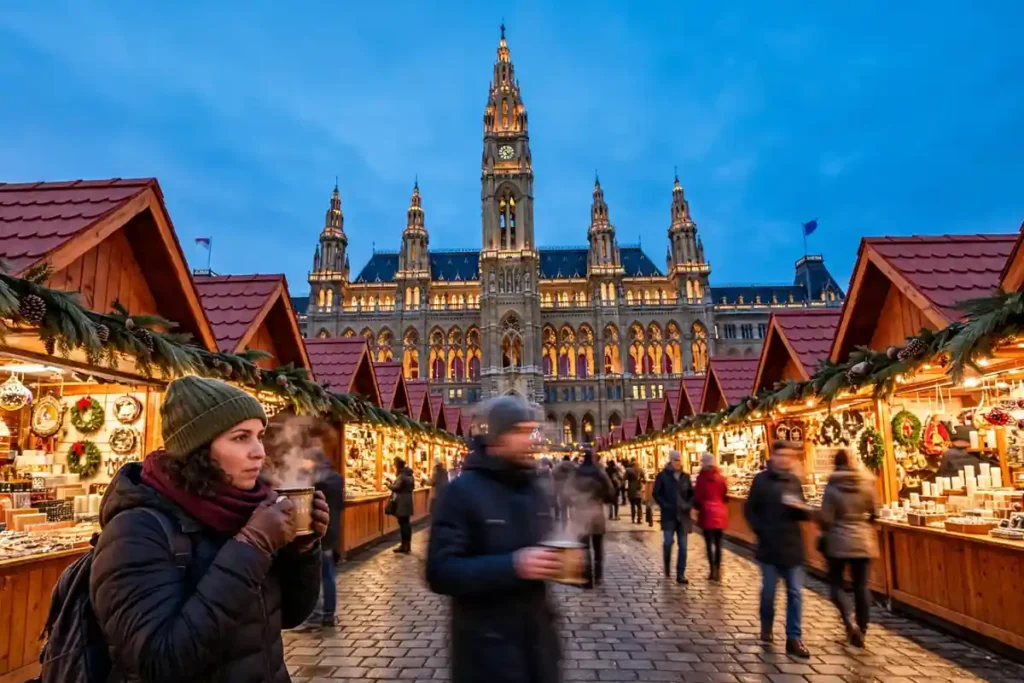
If I had to name one city that does Christmas with complete confidence, it would be Vienna. The Christkindlmarkt in front of the neo-Gothic Rathaus (City Hall) is the headline act, with the building’s facade lit up behind hundreds of stalls and an ice skating rink winding through the neighbouring Rathauspark. It’s busy. It’s also genuinely lovely, especially on a weekday evening when the crowds thin out a little.
Then go beyond it. The market at Schönbrunn Palace has the Habsburg-yellow palace as a backdrop, which is hard to beat. Spittelberg, a small cobbled quarter near the MuseumsQuartier, feels more like a village fair, and the market in the courtyard of the Karlskirche is quieter again. Many locals will tell you the smaller markets are the better ones, and I agree with them.
What to eat and drink: Punsch (a spiced hot drink, often fruit-based), Maroni (roasted chestnuts), Käsespätzle, and a slab of Sachertorte at Café Sacher once your feet give up. Kinderpunsch is the alcohol-free version, so nobody has to miss out.
Best for: couples, culture lovers, anyone who wants a polished, grown-up Christmas. Add a classical concert (Vienna is the city of Mozart and Strauss, after all) and you’ve got a proper trip.
Also Read: Things to Do in Vienna at Christmas: 24 Magical Experiences
2. Strasbourg, France
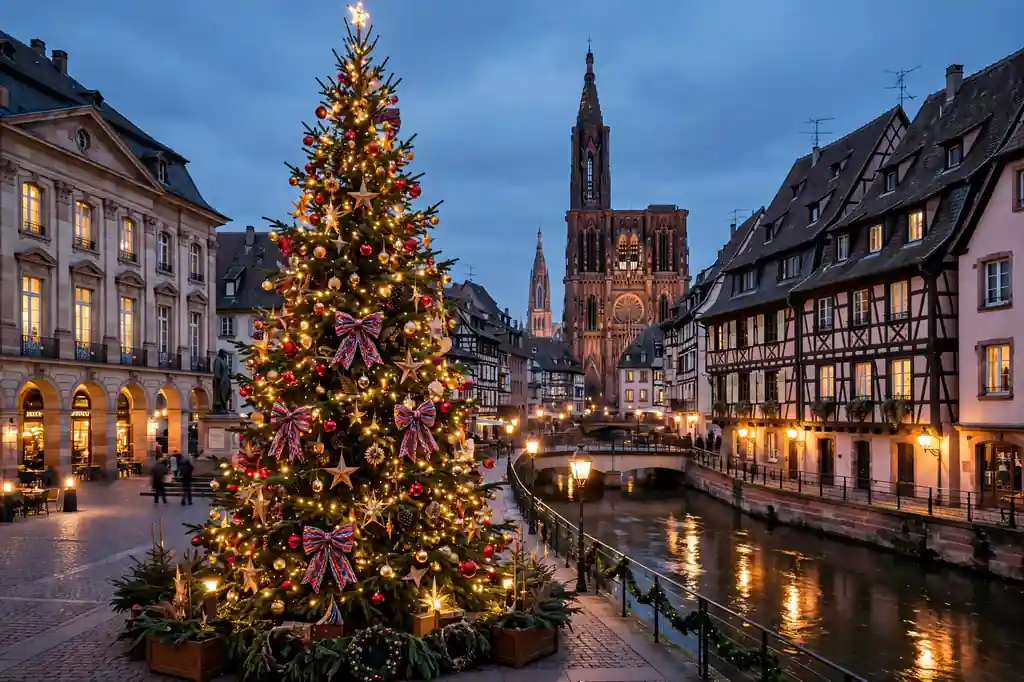
Strasbourg calls itself the “Capitale de Noël”, and it has the receipts. Its Christkindelsmärik dates back to 1570, which makes it one of the oldest Christmas markets in Europe. The city is in Alsace, right on the German border, so the food, architecture and even the language of some old street names blend French and German in a way you don’t find anywhere else.
The giant Christmas tree on Place Kléber is the centrepiece, and the market stalls fan out around the Gothic Cathédrale Notre-Dame, whose red sandstone spire rises over the old town. Wander toward La Petite France, the canal quarter with half-timbered houses, and you’ll understand why people fall for this place.
What to eat and drink: vin chaud (mulled wine), bredele (small Alsatian Christmas biscuits), tarte flambée (also called flammekueche, a thin crispy flatbread with cream, onions and bacon), and pain d’épices. Order the tarte flambée at a proper winstub, not a stall, if you can.
A practical note: it’s crowded, particularly on weekends. Go early in the morning or on a weekday, and consider staying in a neighbouring Alsatian village like Colmar, which has its own market, and train in.
3. Prague, Czech Republic
Prague at Christmas has an almost theatrical quality. The main market sits in Old Town Square (Staroměstské náměstí) under the Gothic Týn Church and beside the Astronomical Clock, which draws a small crowd every hour. A huge tree stands in the middle of the square and the whole thing glows after about four in the afternoon.
Wenceslas Square has its own market too, but I’d put more of your time into the walk across Charles Bridge and up toward Prague Castle. In the evening, with the bridge nearly empty and the castle lit up, you’ll forget the crowds.
One cultural quirk worth knowing: Czech families traditionally eat carp on Christmas Eve, and in the days beforehand you’ll see live carp sold from big tubs on the street. Some visitors find that surprising, others find it charming. It’s part of how locals celebrate Štědrý večer (Christmas Eve), so just be prepared.
What to eat and drink: svařák (Czech mulled wine), klobása (grilled sausage), and trdelník, the chimney-shaped pastry. Fair warning: trdelník is more of a tourist invention than a Czech tradition, though it’s tasty enough. Prague is also a great value pick for the budget-conscious.
4. Nuremberg, Germany
Germany has hundreds of Christmas markets, and picking a favourite starts arguments, but Nuremberg’s Christkindlesmarkt is the one most people mention first. It fills the Hauptmarkt square beneath the Frauenkirche, and it opens with a ceremony in which a young local person dressed as the Christkind (the “Christ child” gift-bringer of Bavarian tradition) delivers a prologue from the church balcony.
The stalls here are famously strict about quality and craft, so you’ll find hand-made ornaments, wooden toys and the odd Zwetschgenmännle, a little figure made of dried prunes that looks slightly creepy and is completely beloved. Eat Nürnberger Rostbratwürste (small grilled sausages, served on a pewter plate or in a bun, usually in threes or sixes) and Lebkuchen, the soft spiced gingerbread the city is known for.
One thing to remember in Germany: your Glühwein mug usually comes with a small deposit (Pfand). Return it for your money back, or keep it as a souvenir. Cheap, practical and a nice excuse to carry something home.
Other German cities worth a look if you have more time: Dresden (whose Striezelmarkt is one of the country’s oldest), Cologne (with several markets, the cathedral setting is superb), and Munich, where the Marienplatz market fits in well with a Bavarian weekend.
5. Salzburg, Austria
Salzburg is smaller and calmer than Vienna, with a postcard setting: baroque churches, the Hohensalzburg Fortress on the hill, and the Alps behind. The Christkindlmarkt at Domplatz, near the cathedral, is the main one, with another around the Hellbrunn Palace if you have time.
There’s also a Christmas connection you may not know about. The carol “Silent Night” (Stille Nacht) was first performed in 1818 at a church in Oberndorf, a short trip north of Salzburg. A small memorial chapel stands there now, and visiting it on a quiet morning feels more moving than I expected. Fans of The Sound of Music will find plenty of that too, but the Christmas history is the real draw.
Best for: couples and anyone who likes their Christmas gentle and a bit musical. Pair it with a day trip into the Salzkammergut lake region if the weather’s clear.
Also Read: Best Things to Do in Bruges: 22 Unmissable Experiences (Plus Local Tips and Easy Itineraries)
Cosy Northern Europe: Hygge, Candles and Old Towns
6. Copenhagen, Denmark
Copenhagen doesn’t shout about Christmas, which is part of the appeal. The Danes have a word, hygge, for the feeling of being warm, safe and comfortable with people you like, and in December the whole city leans into it. Candles in every window, wool blankets on cafe chairs, pastries on every counter.
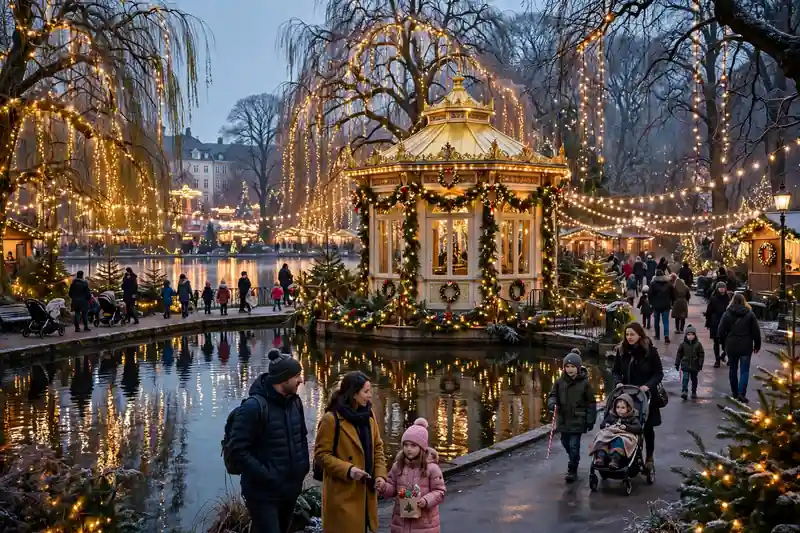
Tivoli Gardens, the historic amusement park right in the city centre, is transformed for the season with lights, a Christmas market and winter rides, and it’s honestly one of the best family Christmas experiences in Europe. Nyhavn’s colourful waterfront has a market too, and the Christmas lights on Strøget make for an easy evening walk.
What to eat and drink: gløgg (Danish mulled wine, served with raisins and almonds), æbleskiver (round puffed pancakes dusted with sugar), and risalamande, the rice pudding with a hidden whole almond that wins someone a prize. Danes take this game seriously.
Heads up: Copenhagen is expensive, and the weather is more grey drizzle than Hollywood snow. Pack a good waterproof coat and don’t expect a white Christmas.
7. Tallinn, Estonia
Tallinn is the pick for people who want a fairy-tale medieval setting without a big bill. The Old Town is a UNESCO World Heritage Site with towers, narrow lanes and steep roofs, and the Christmas market in Town Hall Square (Raekoja plats) is exactly what you imagine when you think of old-world Christmas.
The city also claims one of the first public Christmas trees in Europe, said to have been put up in this very square in 1441. Whether or not that stands up to every historian, locals are proud of it, and the tree is still the centre of the market.
What to eat and drink: gingerbread, roasted almonds, blood sausage with lingonberry jam (a traditional Estonian Christmas dish that’s more delicious than it sounds), and hot glögi. Pair it with a short ferry or flight from Helsinki and you’ve got an easy two-country trip.
8. Kraków and Budapest: Two Smart Budget Picks
If prices in Vienna or Copenhagen make you wince, look east.
Kraków, Poland has a market on the enormous Main Square (Rynek Główny), flanked by St. Mary’s Basilica and the Cloth Hall. The city is also known for its szopki, elaborate nativity scenes built as miniature versions of Kraków’s own buildings, a tradition recognised by UNESCO as part of humanity’s intangible cultural heritage. There’s a competition every December, and the winners are displayed in the square. Eat pierogi, grilled oscypek cheese with cranberry, and drink grzaniec, Polish mulled wine.
Budapest, Hungary has markets at Vörösmarty Square and in front of St. Stephen’s Basilica, where a light show is projected onto the facade. Try kürtőskalács (chimney cake, baked over coals and rolled in sugar), lángos, and a long soak in one of the thermal baths, which is a great reward for cold feet. Szechenyi is the famous one, though locals often prefer quieter options.
Both cities are cheap by Western European standards, and both are walkable. Few places give better value for a Christmas trip.
Also Read: Best Things to Do in Warsaw: 25 Unmissable Experiences for 2026
Snow, Reindeer and the Northern Lights
9. Rovaniemi, Finnish Lapland
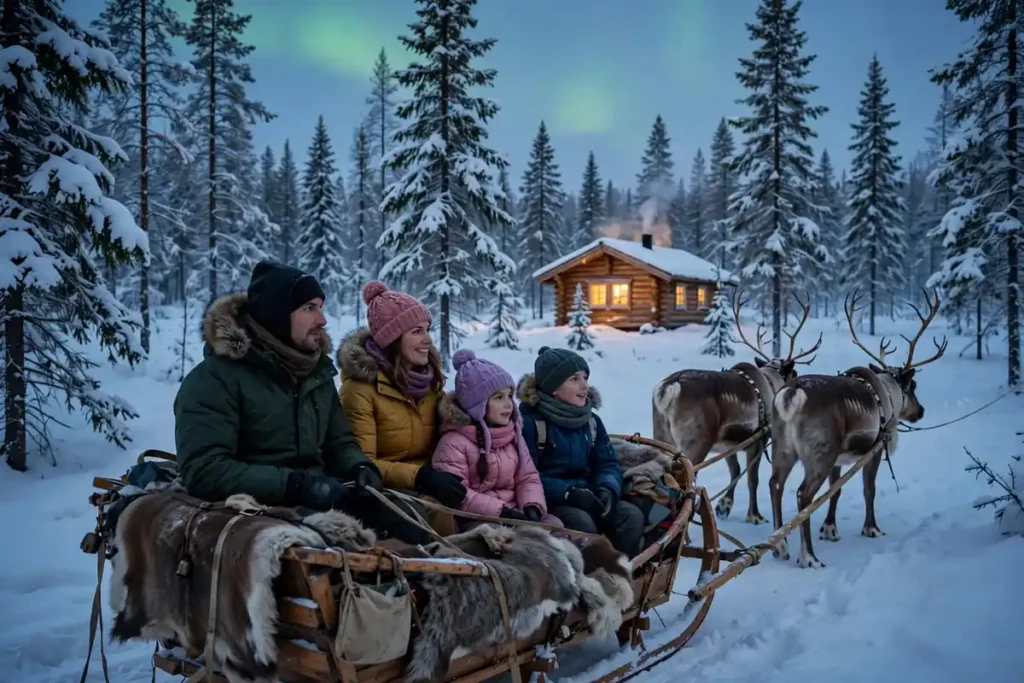
If your idea of Christmas involves proper snow, Rovaniemi is hard to beat. This is the capital of Finnish Lapland, and it sits right on the Arctic Circle, which is exactly where the Santa Claus Village has planted its flag. You can cross the Arctic Circle line painted on the ground, meet Santa at his office, send a postcard stamped with the Arctic Circle postmark, and ride in a reindeer sleigh in the same afternoon. It sounds cheesy, and a little bit it is. Kids lose their minds with joy anyway, and adults tend to quietly melt too.
Beyond the village, there’s plenty to do. Husky sled rides, snowmobile safaris, ice swimming followed by sauna (the Finns take this very seriously), and the Arktikum museum, which explains life in the Arctic in a way that’s genuinely interesting. With luck and clear skies, you might see the northern lights too. Nobody can promise that, so treat it as a bonus.
Finland has a lovely Christmas tradition worth mentioning: the Declaration of Christmas Peace in Turku, a ceremony held at noon on Christmas Eve that goes back centuries and is broadcast across the country. If you’re in Finland on the 24th, many families also visit cemeteries to light candles for loved ones, which creates a quiet, glowing landscape that’s surprisingly beautiful.
Be honest about the cost. Lapland at Christmas is one of the priciest trips in this guide, and it books out early. Flights, cabins and activity packages can fill months ahead. If you’re searching in mid-November, look at smaller operators and nearby towns like Levi or Saariselkä, or consider going in the first week of December, when it’s slightly cheaper and still wonderfully wintry. Dress in real thermal layers, not fashion layers. You’ll thank yourself.
10. Tromsø, Norway
Tromsø sits well inside the Arctic Circle in northern Norway, and in December the sun doesn’t properly rise at all. That period, known as the polar night, sounds bleak but really isn’t. The sky glows with deep blue and pink twilight in the middle of the day, and when the weather clears, the aurora borealis puts on a show that’s frankly difficult to describe.
Beyond the lights, Tromsø offers whale watching in winter, when orcas and humpbacks follow herring into the nearby fjords. Reindeer experiences with the Sami people, a visit to the Arctic Cathedral, and a ride up the Fjellheisen cable car for views over the city are all good ways to fill the days. Norwegians also love a proper Christmas feast, with ribbe (pork belly) or lutefisk on the menu, though you’ll probably settle for something simpler in a restaurant.
It’s a smart pick for travellers who want drama over tradition. Just remember that northern lights tours depend on cloud cover, so give yourself at least three or four nights to improve your odds.
Big-City Christmas: London and New York
11. London, England
London does Christmas on a grand scale, and it begins long before December. The lights on Regent Street and Oxford Street, the enormous tree in Trafalgar Square (a yearly gift from Norway, as thanks for Britain’s help during the Second World War), the department store windows on Oxford Street, and the ice rink at Somerset House all add up to something special.
Winter Wonderland in Hyde Park is the big, loud, family-friendly one with rides, a market and plenty of food. If you’d rather avoid the crowds, try Covent Garden, the South Bank Centre Winter Market beside the Thames, or Kew Gardens’ after-dark illuminated trail, which turns the botanic gardens into a glowing walking route. For something quieter again, hear a carol concert at a church or at the Royal Albert Hall.
A tip for the days around the 25th: public transport in London largely stops on Christmas Day, and most shops and many restaurants close. Plan your Christmas Day carefully and book a hotel meal in advance if you don’t want to hunt for a sandwich.
If you have a day to spare, take the train to Cambridge. King’s College Chapel’s Festival of Nine Lessons and Carols, broadcast around the world on Christmas Eve, is the one many people grew up hearing on the radio. Getting a seat is extremely difficult, though queuing for tickets in the cold is a time-honoured tradition for the dedicated.
Edinburgh, Scotland deserves a mention here too. The Christmas market in Princes Street Gardens, set beneath the castle on its volcanic rock, is one of the UK’s most picturesque. Better still, if you can stretch your trip to New Year, Edinburgh’s Hogmanay celebrations are among the best in the world.
Also Read: Best Things to Do in Soho London: 30 Unmissable Ideas for Every Kind of Visitor
12. New York City, USA
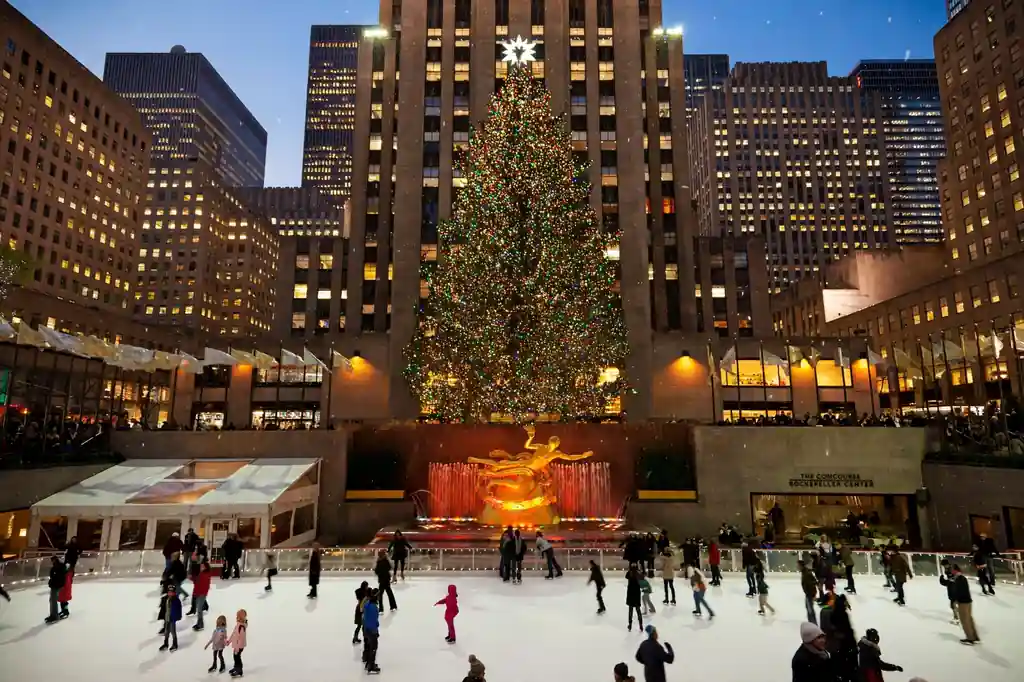
New York is a bit of a cliche for Christmas, and it earns it. The tree at Rockefeller Center, the ice rink beneath it, the Fifth Avenue window displays at Saks and Bergdorf Goodman, the Radio City Music Hall Christmas Spectacular with its Rockettes, and Bryant Park’s Winter Village with its skating rink and holiday shops are all classic stops. Add a performance of The Nutcracker by New York City Ballet at Lincoln Center, and you’ve had a full movie-style Christmas.
If you want something a little more local, take the subway to Dyker Heights in Brooklyn, where residents deck their houses with giant, wildly elaborate light displays. It’s gaudy, glorious and a lot of fun, particularly if you go with kids.
A couple of honest warnings. Rockefeller Center and Fifth Avenue are packed, especially on weekends and in the week before Christmas. Hotels are pricey, and the cold wind between skyscrapers can be brutal. Go on a weekday morning, bring warm gloves, and accept that you’ll be shuffling slowly with thousands of other people. It’s worth it.
13. Quebec City and the Canadian Rockies
Quebec City is the most European-feeling city in North America, and at Christmas it turns into a snow globe. Old Quebec, a UNESCO World Heritage Site, has narrow stone lanes, the grand Château Frontenac overlooking the St. Lawrence River, and the charming Petit Champlain quarter, which is lit up with thousands of lights. The German Christmas Market sets up near the Hotel de Ville, and locals warm up with caribou (a hot spiced wine drink), tourtière (meat pie), and maple everything.
It gets seriously cold, often far below freezing, so pack accordingly. In exchange, you get proper snow and the kind of atmosphere that photographs beautifully.
For mountains rather than medieval streets, the Canadian Rockies deliver. Banff in Alberta has a pretty main street dressed for the season, skiing at nearby resorts, and ice skating on Lake Louise, with a frozen lake and glaciers behind it. It’s an awesome choice for active travellers who’d rather be on skis than shopping.
Warm-Weather Christmas Escapes
Not everyone wants to shiver. Some of the happiest Christmases happen in flip-flops.
14. The Philippines
No country starts Christmas earlier or takes it more seriously. Filipinos call the months from September to December the “Ber months”, and Christmas music is playing in shopping malls long before most of the world has thought about turkey. The celebration builds to Simbang Gabi, a series of nine dawn masses from December 16th to 24th, after which families gather for traditional treats like bibingka (rice cake cooked with coconut milk) and puto bumbong (purple rice steamed in bamboo).
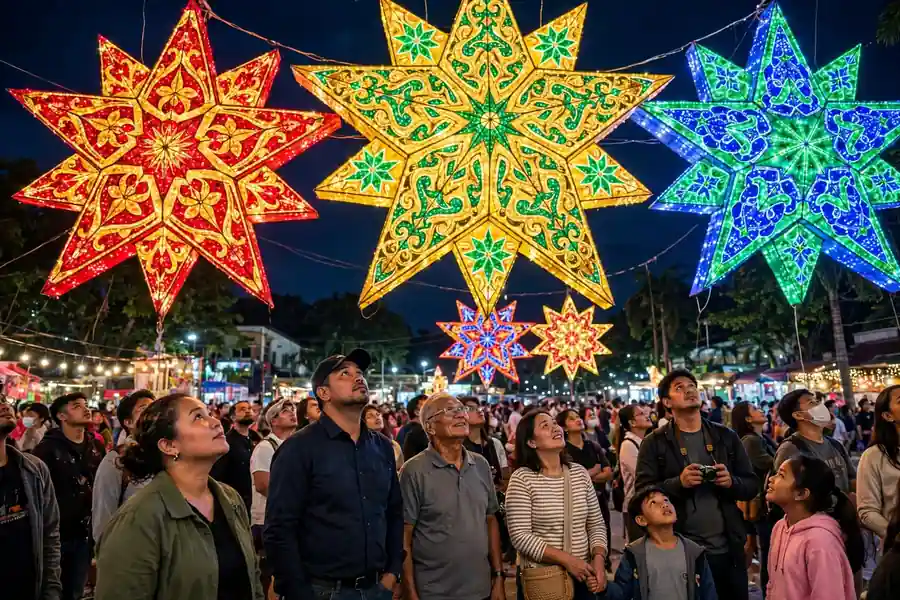
The country’s most spectacular spectacle is the Giant Lantern Festival in San Fernando, Pampanga, often called the Christmas Capital of the Philippines. Huge, rotating, kaleidoscopic lanterns called parols, sometimes several metres across, compete in a dazzling contest. The festival is typically held on a Saturday in mid-December, so check the date before you book.
The weather is warm and mostly dry at this time of year, which makes it an ideal time for island hopping in Palawan or Cebu once the celebrations wrap up. It’s a Christmas that feels loud, warm and affectionate in a way that’s hard to replicate elsewhere.
15. Oaxaca, Mexico
Mexico does Christmas in a style all its own. From December 16th to 24th, communities hold posadas, processions that re-enact Mary and Joseph’s search for lodging, ending in a party with piatas, hot ponche (fruit punch), tamales and buñuelos. Oaxaca takes it a step further with the Noche de Rbanos, the Night of the Radishes, on December 23rd. Local artists carve giant radishes into elaborate nativity scenes, dragons, and local figures, then display them in the zcalo. It’s one of the most unusual Christmas events in the world, and the queue to see it can be long.
Oaxaca’s food alone is worth the flight: mole, tlayudas, mezcal and fresh chocolate. Days are warm, nights are cool, and the city’s colonial streets are beautiful. Book accommodation early, as the Night of the Radishes draws big crowds.
16. Sydney and the Australian Summer
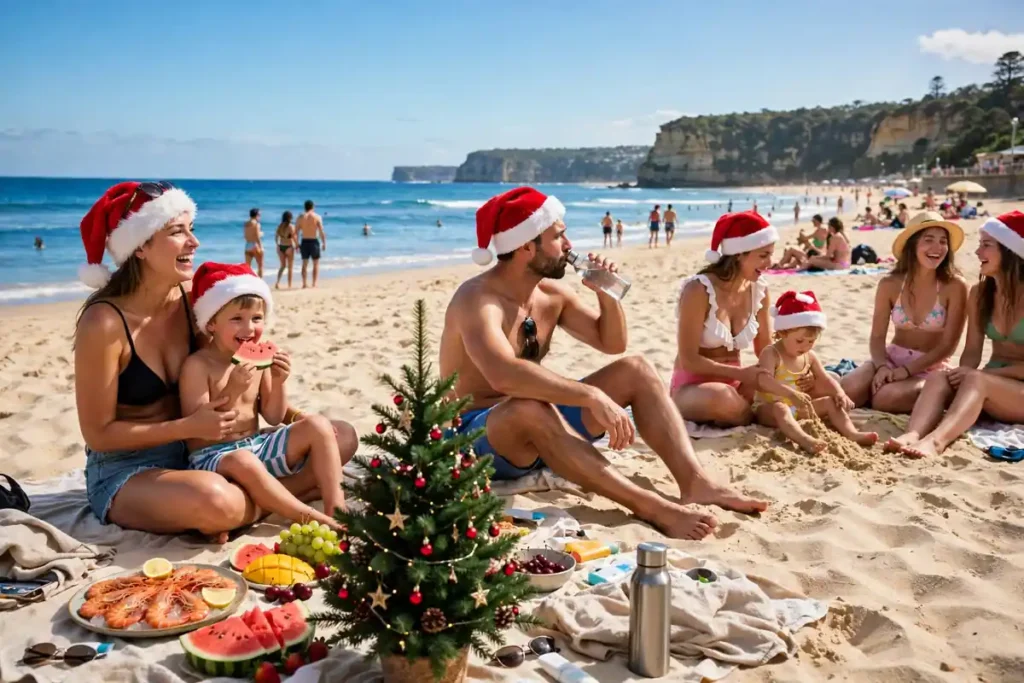
Australians celebrate Christmas in summer, which flips everything you assumed about the holiday. Families head to Bondi Beach for a swim on Christmas morning, then eat cold prawns, ham and pavlova for lunch, often outdoors. Sydney itself is beautifully decorated, with a large tree at Martin Place and lights across the harbour, and the fireworks over Sydney Harbour on New Year’s Eve are famous worldwide.
If you’re from the northern hemisphere, it takes a day or two to adjust to the idea of Santa in shorts. Once you do, it’s genuinely brilliant. Book well ahead, because Christmas is peak season for Australian domestic travel.
Also Read: Best Things to Do in Singapore: A Real-World Guide to What’s Actually Worth Your Time
17. Dubai and the Maldives
For travellers in Asia or the Middle East, Dubai and the Maldives are the easy, sunny options. Dubai has plenty of Christmas trees in the malls, festive brunches at the big hotels, and mild, pleasant weather that’s perfect for the beach, the desert and outdoor dining. Hotels get expensive from late December, so look at prices early.
The Maldives is the “nothing but a beach and a book” Christmas, with overwater villas and warm lagoons. It isn’t cheap, but a few resorts offer package rates, particularly if you book several weeks out. It’s a good choice if what you want most is rest.
Places Where Christmas Means Something More
18. Rome and Vatican City
For many people, Christmas is first and foremost a religious holiday, and few places connect you to it like Rome. At St. Peter’s Basilica in Vatican City, the Pope celebrates Midnight Mass on Christmas Eve, and on Christmas Day he gives the Urbi et Orbi blessing from the basilica’s balcony. Attending either usually requires free tickets that must be requested in advance, so don’t just turn up and hope.
Beyond the Vatican, Rome’s presepi (nativity scenes) fill churches and piazzas, and Piazza Navona hosts a market that traditionally continues until Epiphany on January 6th, when the Italian witch La Befana brings sweets to children. Rome is relatively mild, uncrowded in the evenings, and filled with some of the best food on earth.
19. Bethlehem
Bethlehem, in the West Bank, is the birthplace of Jesus according to Christian tradition, and the Church of the Nativity in Manger Square is among the oldest continuously used churches in the world. Visitors from around the globe have long travelled here for Christmas, and the celebration, including the Christmas Eve procession and midnight mass, is deeply moving.
A serious note: conditions in the region change quickly, and travel advice can shift from month to month. Check your government’s current travel advisories and the latest news carefully before planning, and consider whether it’s the right moment. If you’re considering it, talk to local tour operators and your embassy first.
Practical Tips for Planning Your Christmas Trip
A few things I wish somebody had told me earlier.
Book flights and accommodation as early as possible. Christmas week prices rise sharply, and the best-located hotels vanish first. If you’re travelling this year, don’t wait for a bargain that may never come.
Understand the closures. In much of Europe, Christmas Eve afternoon, Christmas Day and often Boxing Day or St. Stephen’s Day on the 26th are quiet. Shops, restaurants and public transport can be shut. Stock up on snacks, and book a restaurant in advance for the 24th or 25th.
Go early in the season if you can. Mid-to-late November and the first week of December are noticeably quieter at the big markets, and prices are better. If you can only travel in the last week, pick a city that stays lively after the 24th, like London, New York, Vienna or Sydney.
Dress for the cold, not for the photos. Wool socks, thermal base layers, waterproof boots and a hat matter more than a fashionable coat. You’ll be standing in line outside for a lot of the trip.
Also Read: Travel Packing Hacks: 45 Smart Tricks to Pack Lighter, Faster and Smarter
Carry some cash. Most market stalls take cards these days, but not all, and small bills help with small purchases.
Watch your belongings. Crowded markets and busy squares are a pickpocket’s dream. Keep your bag zipped and your phone in an inside pocket.
Get travel insurance. Winter weather can cancel flights and trains, and a decent policy is cheap compared with a ruined holiday.
Be kind to the people working. Everyone serving mulled wine in a freezing stall at 9 p.m. is doing it so you can have a nice evening. A smile and a thank-you go further than you’d think.
Quick Guide: Which Destination Suits You?
- Romantic Christmas: Salzburg, Strasbourg, Vienna, Quebec City
- Travelling with young children: Rovaniemi, Copenhagen (Tivoli), London, New York
- On a tight budget: Kraków, Budapest, Tallinn, Prague
- Warm and sunny: Sydney, the Philippines, Dubai, the Maldives
- Snow and northern lights: Rovaniemi, Tromsø, Banff
- Culture and history: Rome, Vienna, Prague, Oaxaca
- Big-city energy: New York, London
Final Thoughts
There’s no single best place to go for Christmas, and anybody who tells you there is has probably only travelled to one or two. What there is, is a best place for you, this year, with this budget and these people. Start by deciding whether you want snow or sun, quiet or lively, tradition or adventure, then use the picks above to narrow it down. The best places to go for Christmas are the ones that fit how you actually like to travel.
If you’re still unsure, I’d say this. Pick somewhere with a good walkable centre, leave a few hours free each day with no plan, and don’t try to cram in every sight. The best Christmas moments rarely happen on the itinerary. They happen over a paper cup of something hot, on a cold bench, watching the lights come on.
Safe travels, and happy Christmas.
Frequently Asked Questions
What is the best place to go for Christmas in Europe?
Vienna, Strasbourg and Prague are the usual front-runners, depending on your taste. Vienna is polished and grand, Strasbourg feels like walking through a Christmas card, and Prague is best for atmosphere and value. If you only pick one and you want the classic market experience, choose Vienna.
Where can I see snow at Christmas?
Your best chances are in Finnish Lapland (Rovaniemi), northern Norway (Tromsø), Quebec City and the Canadian Rockies. All of them usually have proper snow cover in late December, though the northern lights are never guaranteed, so treat them as a bonus rather than a promise.
What are the cheapest places to go for Christmas?
Kraków, Budapest, Tallinn and Prague tend to be the most affordable in Europe. In Asia, the Philippines offers excellent value. Book early and travel midweek if you can, because Christmas week itself is the most expensive time to fly.
Are Christmas markets open on Christmas Day?
Most European markets close on December 23rd, 24th or 25th, though a few stay open into late December. Always check the official market dates before you book, because they vary by city and by year.
Is it too late to book a Christmas trip now?
It isn’t too late, but you should act soon. Flights and the best hotels get expensive and scarce quickly at this point in the year. If your first choice is full, look at a nearby city with similar markets, or travel a few days before Christmas Day itself, when prices often drop.
Where is the best place for a warm Christmas?
The Philippines for festivity, Sydney for beach life, Oaxaca for culture, and Dubai or the Maldives for easy sunshine. All are warm in late December and all celebrate Christmas in their own distinct way.
When is the best time to book Christmas flights and hotels?
Book as early as you can — Christmas week is the most expensive time to fly, and the best hotels sell out first. Travel midweek or a few days before Christmas Day if you can, when prices often drop.
Which Christmas destination is best for families with children?
Rovaniemi in Finnish Lapland is the classic family pick, with Santa, reindeer sleighs and snow. Copenhagen’s Tivoli Gardens and New York’s Rockefeller Center are also strong choices for children.
What should I pack for a Christmas market trip?
Warm layers, waterproof shoes with grip, gloves and a hat — you will be outside for hours. A small day bag helps for market purchases, and a portable charger is useful in the cold.
How do I choose between a snowy Christmas and a warm one?
Pick snow if you want markets, lights and a classic Christmas feel — Vienna, Strasbourg, Rovaniemi or Tromsø. Pick warm if you want sun and a different kind of celebration — Sydney, the Philippines, Oaxaca, Dubai or the Maldives.