
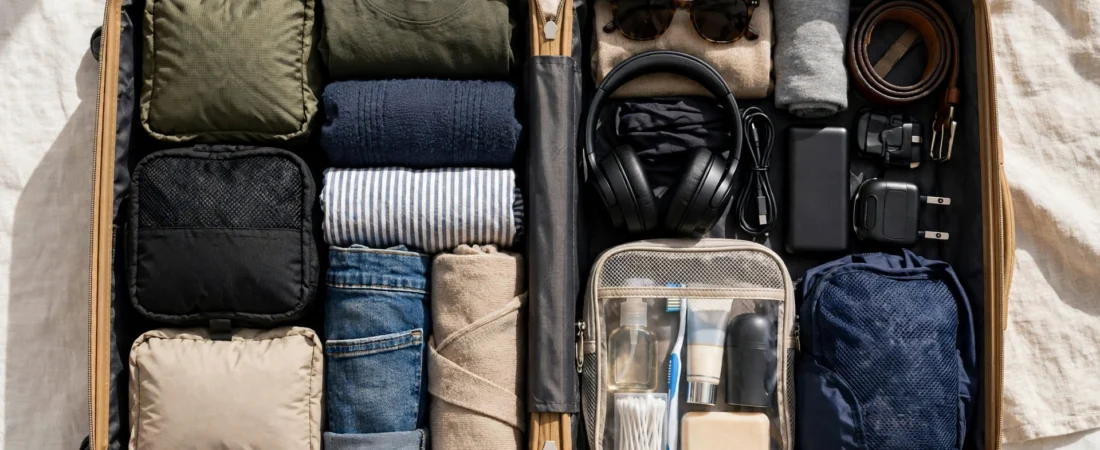
Let me guess how your last packing session went. Three days before the trip you told yourself you would start early. The night before, you were sitting on your suitcase, trying to close a zip that clearly wanted nothing to do with you. Somewhere between the second pair of “just in case” jeans and the fourth pair of shoes, you lost control.
I have been there more times than I want to admit. And after years of weekend trips, long-haul flights, cramped budget airline cabins and one memorable trip where my charger stayed home on the bed, I can tell you something comforting: packing badly is not a personal flaw. It is a skill nobody teaches us, and like any skill, it gets easier once you know a few tricks.
Also Read : Things To Do In Rome That Will Make You Fall Completely In Love With The Eternal City
That is exactly what this guide is. These are travel packing hacks that genuinely work, grouped by the problem they solve: too much stuff, too little space, wrinkled clothes, leaking bottles, tangled cables, overweight bags and the dreaded airport repack on the floor of the terminal. Some are classics you may already know. Others are small details that make a surprisingly big difference.
Grab a coffee, and let’s make your next trip the easiest one you have ever packed for.
Why Packing Hacks Actually Matter
It is easy to dismiss packing hacks as internet fluff. But smart packing solves real, expensive problems.
- Baggage fees. Many airlines charge for checked bags, and overweight fees can be steep. A bag that is 2 kg over the limit can cost more than the shirt that caused it.
- Time and stress. A repeatable system means you are not rethinking everything before every trip.
- Comfort. Hauling a heavy bag over cobblestones, up hostel stairs or through a crowded metro is miserable. Light bags make you more flexible and more willing to say yes to spontaneous plans.
- Fewer forgotten items. Good systems catch the things you normally forget, like chargers, medication and that one adapter.
- Better outfits. When you plan what you pack, you end up wearing everything you brought, instead of dragging around clothes that never leave the suitcase.
The goal is not to become a minimalist who survives a month on two T-shirts. The goal is to bring what you will use, protect it, find it quickly and still have room to bring home a souvenir or two.
Part 1: Planning Hacks to Do Before You Touch Your Suitcase
The best packing hacks happen before anything goes in the bag. Spend twenty minutes here and the actual packing becomes almost automatic.
1. Start a Master Packing List and Reuse It
If you travel more than once a year, create one master list on your phone and reuse it every time. Split it into sections: documents, clothes, toiletries, tech, health, extras. Before each trip, duplicate the list, delete what does not apply and add anything specific to the destination.
The real magic is that your list improves over time. Every time you realise you forgot something, add it. After a few trips, your list becomes a custom safety net built from your own mistakes, which is far more useful than any generic template.
2. Check the Weather, Then Check It Again
Look at the forecast a week before you leave and again two days before. Do not just look at the temperature. Check rain probability, humidity and the gap between daytime highs and evening lows. A destination that is 28°C at noon can feel chilly at 9 pm, and that is where a light layer earns its place.
Also think about what you will actually be doing. Hiking, a business meeting and a beach day need very different clothes, so build your list around activities rather than just dates.
3. Plan Outfits, Not Individual Items
This is the single habit that separates efficient packers from everyone else. Instead of throwing in “five tops and three bottoms”, plan actual outfits. Lay them out on the bed, or write them down: top, bottom, layer, shoes.
A handy formula many travellers use is to pick a base of neutral colours, add one or two accent colours, and make sure every top works with every bottom. If an item only works in a single outfit, it is a candidate to leave behind. Aim for pieces that can be worn at least three different ways.
4. Lay It All Out, Then Remove a Third
Once you have gathered everything, place it on the bed and look at it honestly. Then put back about a third. Yes, really. Almost everyone overpacks, and almost nobody regrets leaving things at home. The “just in case” pile is usually the heaviest and least used part of any suitcase.
A useful test for each item: would I buy this at my destination if I needed it? For most things, such as a spare umbrella, extra shampoo or a basic cardigan, the answer is yes, and you can cross them off.
5. Build a Laundry Plan Instead of Packing for Every Day
You do not need fourteen outfits for a fourteen-day trip. Pack for roughly a week, and plan to wash once. Options include a hotel or hostel laundry, a nearby laundromat, a laundry service (often cheap and quick in many countries) or a quick sink wash with a few drops of travel detergent.
If you know you will do laundry, quick-dry fabrics like merino wool, nylon blends and lightweight synthetics make a huge difference. They dry overnight on a hanger or a towel rail.
6. Pack Early, But Finalise Late
Start assembling a few days ahead so you have time to notice gaps, buy missing items and avoid last-minute panic. Keep a “launch pad” spot, like a chair or corner of the room, where everything destined for the trip accumulates. Then do a final check the night before, adding fresh items like toiletries, phone and wallet.
7. Weigh Your Bag at Home
A cheap digital luggage scale costs very little and can save you from a gate-side meltdown. Weigh your bag before you leave, and again once you have added souvenirs on the way home. If you are close to the limit, you will know exactly what to move to your carry-on or wear on the plane.
Must Read : Best Cities to Visit in Europe: 18 Places Worth the Flight
8. Photograph and Back Up Your Documents
Take clear photos of your passport, visas, travel insurance, booking confirmations, driver’s licence and the front and back of your cards. Store them in a secure folder or password manager, and email a copy to yourself or a trusted contact. If anything is lost or stolen, having these on hand will speed up replacements dramatically.
Part 2: Choosing the Right Luggage Is a Hack in Itself
You can know every folding trick in existence, but if your luggage is wrong for the trip, you will struggle.
9. Go One Size Smaller Than You Think You Need
Space expands to fill the container. A big suitcase invites you to fill it, and then you are paying to lug it around. Choosing a carry-on sized bag forces better decisions and lets you skip check-in queues, baggage carousels and the risk of lost luggage. For trips under two weeks, carry-on only is realistic for most people.
10. Pick Luggage That Matches the Trip
A hard-shell spinner glides beautifully through airports and protects fragile items, but it can be awkward on cobblestones and rough pavements. A soft-sided bag or backpack squeezes into overhead bins and tight spaces more easily and handles rough terrain better. If your trip involves lots of stairs, trains or unpaved roads, a backpack or a bag with large wheels is usually the better pick.
Always check your airline’s current cabin and checked bag size and weight limits before you buy or pack, because they vary widely, especially on budget carriers.
11. Use the Personal Item as a Second Bag
Most airlines allow one carry-on plus a small personal item that fits under the seat. A well-chosen backpack or tote can hold a surprising amount, including a change of clothes, a laptop, snacks, chargers and a jumper. Put your heaviest and most valuable items here so you always have them at hand.
12. Look for Smart Features, Not Gimmicks
Useful features include an expandable zip (use it only on the way home, not on the way out), compression straps, an external USB pass-through if you like it, a laptop sleeve and plenty of internal pockets. Skip anything heavy, because the bag’s own weight eats into your allowance.

Part 3: The Big Four Folding Methods, Tested and Compared
If you search for packing hacks, rolling clothes comes up first. But it is not always the best method. Here is how each approach really performs.
13. Rolling: Great for Casual and Soft Fabrics
Rolling works well for T-shirts, jeans, leggings, shorts, pyjamas and underwear. It reduces hard creases, lets you see everything at a glance and fills gaps well. The downside is that very bulky items such as thick sweatshirts and jackets can take up more room when rolled than when folded flat or compressed.
How to do it: lay the item flat, fold the sleeves or legs in, fold it into thirds lengthwise, and roll tightly from the bottom up. Stack the rolls upright like books so you can see every item.
14. The Bundle Method: Best for Wrinkle-Prone Clothing
Bundle packing wraps clothes around a soft core, like a small pouch of underwear or socks, with the largest items at the bottom and the smallest on top. Everything wraps in layers, so there are no sharp fold lines. It takes a little practice, but it can be excellent for shirts, blouses and dresses you want to arrive in decent condition.
15. The Flat Fold: Best for Structured Garments
Structured shirts, trousers and blazers do better folded flat with minimal creases. Place them at the bottom of the case, with sleeves folded neatly across the body, or fold them around a piece of cardboard or a plastic bag for a smoother crease. The goal is gentle, wide folds rather than tight sharp ones.
16. The Ranger Roll: Compact and Tidy
Popular among outdoor travellers, the ranger roll is a tight roll for T-shirts and trousers, finished by tucking the end into a built-in pocket formed by the fold. It holds its shape and stays compact, which is handy for backpackers.
My honest verdict: use a mix. Roll your casual basics, bundle or flat-fold your dressier pieces, and compress your bulky knits. No single method wins every time.
17. Use Packing Cubes (Yes, They Are Worth It)
Packing cubes are zippered fabric organisers in different sizes. They are probably the most recommended packing item in existence, and for good reason. They keep categories separate, compress clothes slightly, help you unpack in seconds, and make it easy to move things between bags.
A simple system:
- One cube for tops
- One cube for bottoms
- One small cube for underwear and socks
- One cube for sleepwear, swimwear or workout gear
If you do not want to buy cubes, zip-top bags or pillowcases work as a budget alternative. You do not need an expensive set, just a few lightweight ones that match the size of your bag.
18. Try Compression Cubes and Bags for Bulky Items
Compression packing cubes have a second zip that squeezes air out. They are ideal for sweaters, fleece and puffer jackets. Vacuum-style bags work too, though they can make clothes quite wrinkly and sometimes cannot be resealed on the road. A good compromise is a compression cube for the bulky stuff and regular cubes for everything else.
Part 4: Clothing Hacks That Save Space and Sanity
19. Build a Colour Palette
Choose two or three neutral base colours, such as black, navy, beige or grey, and add one or two accent colours. When everything coordinates, you need far fewer items to create plenty of outfits. It also helps hide small stains and makes mixing and matching effortless.
20. Wear Your Bulkiest Items on the Plane
Boots, a coat and a thick jumper take up the most room and weigh the most. Wear them during travel. You will free up serious space, and you will have an extra layer if the cabin is cold. If you get warm, tie the jacket around your bag or stash it in the overhead.
21. Layer Instead of Packing Heavy Single Pieces
Three thin layers are warmer, lighter and more versatile than one chunky sweater. A thermal base layer, a lightweight mid-layer and a packable shell can handle everything from chilly mornings to wet afternoons, and they take up much less space.
22. Choose Fabrics That Work Harder
Merino wool resists odour, which means you can wear it more than once between washes. Synthetic blends dry fast and wrinkle less. Cotton and linen are comfortable but bulky and slow to dry, and linen wrinkles by nature. Match fabric to trip type, and you may be able to cut the number of items in half.
23. Beat Wrinkles Without an Iron
- Hang it in the bathroom. Run a hot shower and let steam relax creases for ten to fifteen minutes.
- Use a travel steamer. Compact ones weigh very little and are brilliant if you travel for work.
- Use dry-cleaning bags. Slip delicate shirts into a thin plastic dry-cleaner bag before folding. The slippery surface reduces friction and helps prevent deep creases.
- Pack smarter. Place wrinkle-prone items on top or inside a bundle.
24. Tuck Small Items Inside Shoes
Shoes take up awkward space, so use them. Fill them with socks, underwear, chargers or small accessories. It keeps their shape, protects them from being crushed and uses space that would otherwise be wasted.
Read Must : Best Vacation Spots That Will Make You Finally Book That Trip You Keep Putting Off
25. Put Shoes in Bags, Soles Facing the Wall
Use a shower cap, a reusable bag or a disposable bag to keep dirty soles away from clothes. Place shoes along the edge of the suitcase, near the wheels, with soles against the outer shell. Heavy items near the wheel end also make a rolling bag more stable.
26. Limit Your Shoes to Three Pairs
Shoes are the biggest space hogs. For most trips, three pairs is plenty: one comfortable walking pair (worn on the plane), one dressier or lighter option, and one pair of sandals or flip-flops. If you can make a single pair of sneakers work with most outfits, you are already ahead of the game.
27. Pack Accessories in a Pill Organiser or Contact Lens Case
Earrings, rings and small jewellery tangle easily. A small pill organiser keeps them separate, and a drinking straw threaded through a necklace chain stops knots. Belts can be rolled up and tucked around the inside edge of your suitcase, saving valuable flat space.
28. Use Dryer Sheets or Scented Sachets
A dryer sheet tucked between clothes keeps your suitcase smelling fresh, which is helpful if you are wearing clothes more than once or storing slightly damp items. Small sachets of baking soda or a bar of soap in a mesh bag can do the same job.

Part 5: Toiletry and Liquid Hacks That Prevent Disasters
29. Know the Liquid Rules Before You Pack
In many countries, carry-on liquids must be in containers of 100 ml (3.4 oz) or less, all fitting in one clear, resealable bag. Some airports have newer scanners that relax these rules, but others still enforce them strictly, so check your departure and arrival airport rules before you go. Pack your liquids bag where you can pull it out quickly at security.
30. Decant Into Small Reusable Bottles
Buy a set of leak-resistant silicone travel bottles and fill them with your regular products. You will save money compared to buying mini sizes, reduce plastic waste and use only what you need. Label each bottle with a marker or tape, so you do not mix up shampoo and conditioner in the shower.
31. Stop Leaks With Plastic Wrap or a Zip Bag
Pressure changes at altitude cause bottles to leak. Place a small square of cling film or plastic wrap under each cap before screwing it on, and put every liquid in a sealed zip bag, even the ones you think are secure. Leave a little air in each bottle so there is room to expand.
32. Switch to Solid Toiletries
Shampoo bars, conditioner bars, solid deodorant, toothpaste tablets, solid perfume and bar soap are leak-proof, lighter and often not counted as liquids. They are a great way to free up space in your quart bag and reduce the mess if something does open.
33. Use Contact Lens Cases for Small Amounts
A contact lens case is brilliant for a few days’ worth of face cream, foundation or hair product. Pill containers work too. Pack exactly what you need rather than a half-full bottle.
34. Keep a Ready-Packed Toiletry Bag
This is one of the best habits for frequent travellers. Keep a duplicate set of travel-sized essentials, like a toothbrush, toothpaste, razor, deodorant and skincare basics, in a dedicated bag that lives in your suitcase or cupboard. When you are packing, you grab it and go, with no forgetting and no raiding your bathroom the night before.
35. Use a Hanging Toiletry Bag
If your hotel or hostel has limited counter space, a hanging bag with a hook lets you suspend everything from a towel rail or door. It also keeps things visible, so you are not digging for the toothpaste in a dark bathroom at 6 am.

Part 6: Tech, Cable and Document Hacks
36. Make a Tech Pouch
Put every charger, cable, adapter, power bank and spare earbud into one padded pouch. When you land, the pouch comes out as a unit, and when you leave, you do a single check instead of hunting around the room. Use small cable ties or a rolled-up hair tie to stop cords from tangling. An old glasses case or a small zip pouch works beautifully if you do not have a dedicated organiser.
37. Bring One Multi-Port Charger and One Adapter
A single multi-port USB charger can replace three or four wall plugs. Pair it with a universal travel adapter that covers your destination, and check voltage compatibility for anything you plug in directly, especially hair dryers and straighteners. Many hotels supply hair dryers, so you may be able to leave yours at home.
38. Remember the Battery Rules
Power banks and spare lithium batteries must travel in your carry-on, not your checked bag, on almost all airlines. Check your airline’s limits on capacity, and tape over exposed terminals on loose batteries. Keep devices you plan to use in flight charged before boarding.
39. Download Everything Before You Leave
Download offline maps, your boarding passes, hotel details, entertainment, translation packs and any tickets you will need. A phone with no signal and no offline content is not much help in a foreign train station. Take screenshots of key confirmations as a backup.
Also Read: Best Things to Do in London: 45 Unmissable Experiences
40. Keep Documents in One Place, and Never in the Checked Bag
Passport, visas, travel insurance, medication prescriptions and printed confirmations belong in your personal item. A slim travel wallet or document sleeve keeps them together. Keep a separate card and a small amount of cash in a different bag, so a lost wallet does not strand you.

Part 7: Carry-On and Airport Hacks
41. Pack a Smart Carry-On Essentials Kit
Assume your checked bag might arrive late, or not at all, and carry the things you cannot afford to lose or do without for 24 hours:
- Passport, wallet, phone and keys
- Any prescription medication, in original packaging
- A change of underwear and a top
- Basic toiletries within the liquid limit
- Chargers and power bank
- Glasses or spare contact lenses
- An empty reusable water bottle to fill after security
This small kit has rescued many trips from delayed bags, and it takes up almost no space.
42. Dress for the Airport, Not Just the Flight
Wear slip-on shoes for faster security checks, a jacket with deep zip pockets for your phone, passport and boarding pass, and layers for fluctuating cabin temperatures. Avoid lots of metal such as heavy belts and jewellery, which can slow you down at the scanners.
43. Put Heavy Items in the Carry-On, Within Limits
If your checked bag is overweight, move dense items such as books, shoes and chargers to your carry-on or personal item. Most airlines weigh carry-ons less strictly than checked luggage, but this varies, and some budget airlines do check. Know your airline’s policy before you try it.
44. Use a Pillowcase Trick Carefully
Some travellers stuff extra clothes into a pillowcase or a scarf and treat it as part of their jacket or neck pillow. It is a popular hack, but it is also one that airlines can and do challenge. Treat it as a last-resort option, not a plan, and be prepared to move items into your bag if asked.
45. Leave Space for the Trip Home
Pack your bag about 80 percent full on the way out. That leaves room for souvenirs, gifts and the clothes that never quite fit back in as neatly the second time. If you plan to shop, pack a foldable duffel or tote, which weighs almost nothing and gives you a bonus bag for the return flight.
Part 8: Protecting Fragile Items and Souvenirs
Bringing home a ceramic bowl or a bottle of olive oil is half the fun of travel, and half the stress. A few simple methods protect your finds.
- Wrap in clothing. Cushion fragile items with soft clothes, socks or a scarf, and place them in the centre of your bag, away from the outer shell.
- Use bubble wrap or bubble mailers. A few sheets take no space and protect breakables.
- Seal liquids twice. Put bottles in a zip bag, then wrap the bag in a sock.
- Check what is allowed. Alcohol, food and plants can be restricted when crossing borders, so check customs rules before you buy.
- Consider shipping. For bulky or very fragile items, posting them home can be cheaper and safer than fighting the baggage allowance.
Part 9: Security and Anti-Theft Packing Hacks
Travel should be relaxing, so a few quiet precautions go a long way.
- Split your valuables. Do not keep all your cash and cards in one place. Keep a backup card and a small emergency stash hidden separately.
- Use a small luggage tag with your name and phone number, with your address hidden or limited. Add a bright strap or ribbon so you can spot your bag instantly on the carousel and avoid picking up someone else’s.
- Put an AirTag or similar tracker in your checked bag and your carry-on. It will not stop a delay, but it will show you where your bag is, which is very reassuring.
- Use zipper clips or small locks on bags in crowded places, and keep your day bag in front of you on busy streets.
- Wear a slim crossbody bag with the zip facing your body in crowded tourist areas.
Part 10: Packing Hacks for Different Types of Trips
Family Trips With Kids
Children change everything about packing, but a few tricks keep it manageable.
- Pack one cube per child, so everyone’s clothes stay separate and unpacking takes a minute.
- Make outfit bundles. Roll a complete outfit together for each day, including underwear and socks. Getting dressed is easy and nobody needs to rummage.
- Pack a spare outfit in the carry-on for each child, plus a spare top for yourself. Spills and accidents happen on planes.
- Bring a small activity kit, with colouring pencils, stickers, a favourite book and downloaded shows, to survive long waits.
- Carry snacks. Hungry children and long delays are a bad combination.
- Pack a few zip bags for wet clothes, dirty laundry and snack leftovers.
Business Trips
The aim here is to arrive looking sharp without checking a bag.
- Choose one neutral colour scheme so jackets, shirts and trousers all mix.
- Wear your blazer and your heavier shoes on the plane.
- Use dry-cleaning bags or a garment folder to protect shirts.
- Pack a mini steamer or lint roller, and use a tech pouch for laptop accessories.
- Keep business cards, your presentation notes and a printed copy of the agenda in your personal item.
Beach and Warm-Weather Holidays
- Pack swimwear in a waterproof bag so wet suits do not soak the rest of your clothes.
- Bring a lightweight, quick-dry travel towel instead of a thick beach towel. Most resorts supply towels anyway.
- Carry reef-safe sunscreen within liquid limits, or buy a full-sized bottle on arrival.
- A lightweight sarong works as a beach cover-up, towel, picnic blanket and scarf.
- Pack sandals that can handle both sand and sightseeing.
Cold-Weather Trips
- Wear your coat and boots on the plane.
- Use compression cubes for sweaters and thermals.
- Choose merino or technical base layers, which keep you warm without bulk.
- Pack a compact hat, gloves and a buff, and keep them in your coat pockets so they do not take suitcase space.
- Include a small bottle of moisturiser and lip balm, because cold air and heating dry the skin.
Backpacking and Long-Term Travel
- Choose a pack that is comfortable, well-fitted and under 40 litres, if you can manage it.
- Pack three of everything and wash regularly, rather than bringing a week’s worth.
- Use a small daypack for daily outings, and keep valuables in a hidden pouch.
- Bring a lightweight padlock for hostel lockers and a sleep sheet.
- Carry a compact first aid kit and a basic sewing repair set.


Part 11: Common Packing Mistakes to Avoid
Even experienced travellers slip up. Here are the mistakes I see (and make) most often.
- Packing for the person you want to be, not the person you are. If you never wear heels at home, you will not wear them in Rome.
- Bringing too many shoes. They weigh a lot and rarely all get worn.
- Forgetting the climate shift. A warm city can have cold evenings, an air-conditioned train or a rainy afternoon.
- Packing everything in the checked bag. Valuables, medication and a change of clothes belong with you.
- Overfilling the bag at the start. No room for souvenirs means a stressful trip home.
- Ignoring airline rules. Sizes, weights and prohibited items change, so check before every trip.
- Leaving packing to the last hour. Rushed packing is how chargers get forgotten.
- Not testing your bag. Lift it, carry it and walk around with it. If it feels heavy now, it will feel worse after a day of travel.
Also Read : Best Holiday Destinations: 20 Places Worth Booking a Flight For
Part 12: The Quick Packing Checklist
Use this as a starting point, and adapt it to your trip.
Documents and money
- Passport or ID, visas and travel insurance
- Boarding passes and booking confirmations (digital and backup)
- Cards, some local cash and a backup card stored separately
Clothing
- Outfits planned around a limited colour palette
- Underwear and socks for the number of days between laundry
- Sleepwear and a swimsuit if needed
- One versatile jacket or layer and comfortable walking shoes
Toiletries and health
- Toiletry bag with travel-sized or solid products
- Prescription medicines in original packaging and a basic first aid kit
- Sunscreen, lip balm and any contact lens supplies
Tech
- Phone, charger, power bank and adapter
- Headphones and any e-reader or laptop
- Offline maps and downloaded entertainment
Extras
- Reusable water bottle, a foldable tote and a few zip bags
- A small padlock and a luggage tag
- A pen for customs forms

Final Thoughts: Pack Less, Enjoy More
Good packing is not about perfection. It is about building a few habits that make travel smoother: plan outfits, choose the right bag, organise with cubes, protect your liquids, keep essentials with you and leave a little room for the trip home. Start with three or four hacks from this list rather than trying all 45 at once. Add more as they become second nature.
And remember, almost anything you forget can be bought at your destination. The things that truly matter, such as your passport, your phone, your medication and a sense of adventure, already fit in your pocket.
Happy travels, and may your zip always close on the first try.
Frequently Asked Questions
1. What is the best way to pack a suitcase to save space?
Use a combination of methods. Roll soft, casual items, flat-fold structured garments, and use packing cubes to keep categories separate. Compress bulky items such as sweaters with compression cubes, wear your heaviest shoes and jacket on the plane, and fill the gaps, like the inside of shoes, with socks and small accessories.
2. Is it better to roll or fold clothes when packing?
It depends on the item. Rolling saves space and reduces creases for T-shirts, jeans, leggings and soft fabrics. Folding or bundling works better for blazers, dress shirts and delicate pieces. Bulky knits can take up more room when rolled, so compress or fold them flat instead.
3. Do packing cubes really work?
Yes, for most people. They do not magically create space, but they compress clothes a little, keep your suitcase organised and make unpacking much faster. If you prefer not to buy them, zip-top bags or pillowcases can do a similar job.
4. How can I stop clothes from wrinkling in my suitcase?
Roll or bundle wrinkle-prone items, put thin dry-cleaning bags around delicate shirts, and avoid overstuffing the case. When you arrive, hang clothes in the bathroom while you shower so the steam relaxes creases, or use a compact travel steamer.
5. How do I pack for a two-week trip with only a carry-on?
Plan for about a week of clothing and do laundry once. Choose a neutral colour palette so everything mixes, limit yourself to three pairs of shoes, wear your bulkiest items on the plane, use solid or decanted toiletries, and check your airline’s exact size and weight limits before you go.
6. How do I stop liquids from leaking in my luggage?
Place a layer of cling film under each cap, leave a little air in the bottle for expansion, and seal everything in a zip bag. Better still, switch to solid toiletries such as shampoo bars and solid deodorant, which cannot leak at all.
7. What should always go in my carry-on instead of my checked bag?
Keep documents, wallet, phone, medication, valuables, chargers, power banks, glasses and a spare change of clothes in your carry-on. Lithium batteries and power banks must travel in the cabin on almost all airlines, and you will be glad to have your essentials if a checked bag is delayed.
8. How can I avoid overweight baggage fees?
Weigh your bag at home with a luggage scale, choose lightweight luggage, wear your heaviest items on the plane and move dense items such as books and shoes to your personal item, if the airline allows. Pack your bag only about 80 percent full so you do not overshoot on the way home.
9. How early should I start packing for a trip?
Start assembling your items two to three days before departure, and finalise on the evening before. That gives you time to wash clothes, buy anything you are missing and avoid the stress of last-minute surprises.
10. What are the best packing hacks for beginners?
Start with a few simple habits: make a reusable packing list, plan outfits around a limited colour palette, use packing cubes, keep a ready-packed toiletry bag and always carry your essentials in your cabin bag. Once these feel natural, add extras like compression cubes, solid toiletries and luggage trackers.