

There’s a particular morning every year when you step outside, catch that first sharp breath of cold air, and think: it’s happening. The maples at the end of the street have gone a little rusty at the edges. The light looks different, lower and honeyed. And somewhere in your chest, a small travel itch starts up.
That itch is exactly why people search for the best places to see fall foliage every single September and October. Autumn color isn’t just scenery. It’s a short, slightly unpredictable, completely free show that nature puts on once a year, and if you time it right, it can be one of the most memorable trips you’ll ever take.
The trouble is that the internet is full of the same recycled lists. Vermont, Vermont, Vermont, a quick nod to Colorado, and done. Those places are famous for good reason, and I’ll cover them properly here. But a great foliage trip depends on more than a famous name. It depends on when you go, how you see it, and whether you pick a place that suits the way you like to travel.
So this guide does a bit more. I’ve pulled together twenty destinations across the United States, Canada, Japan, South Korea, Europe and Pakistan. For each one you’ll get what makes it special, the realistic window for peak color, the best way to experience it, and a few small tips that guidebooks usually skip. Toward the end there’s a planning section on timing, forecasts, packing and avoiding the crowds, plus a FAQ for the questions people ask most.
Pour something warm. Let’s find your autumn.
Also Read : Best Sights In Rome That Will Stop You Mid Step And Take Your Breath Away
Quick Look: Best Places to See Fall Foliage at a Glance
| No | Destination | Typical Peak | Best For |
|---|---|---|---|
| 1 | Vermont, USA | Late Sept to mid Oct | Classic village scenery |
| 2 | White Mountains, New Hampshire, USA | Late Sept to mid Oct | Scenic drives |
| 3 | Acadia and coastal Maine, USA | Early to mid Oct | Ocean plus color |
| 4 | The Berkshires, Massachusetts, USA | Early to late Oct | Cozy weekend escapes |
| 5 | Adirondacks and Catskills, New York, USA | Late Sept to mid Oct | Hiking and lake views |
| 6 | Shenandoah National Park, Virginia, USA | Mid to late Oct | Skyline views |
| 7 | Blue Ridge Parkway and Smokies, USA | Mid Oct to early Nov | Long, slow road trips |
| 8 | Upper Peninsula, Michigan, USA | Late Sept to early Oct | Quiet wilderness |
| 9 | Aspen and Kebler Pass, Colorado, USA | Mid Sept to early Oct | Golden aspens |
| 10 | Columbia River Gorge, Oregon and Washington, USA | Mid Oct to early Nov | Waterfalls plus color |
| 11 | Eastern Sierra, California, USA | Early to late Oct | Mountain lakes |
| 12 | Quebec and the Laurentians, Canada | Late Sept to mid Oct | Culture plus color |
| 13 | Algonquin Provincial Park, Ontario, Canada | Late Sept to early Oct | Canoeing and lakes |
| 14 | Kyoto, Japan | Late Nov to early Dec | Temples and maples |
| 15 | Nikko and Lake Chuzenji, Japan | Mid Oct to early Nov | Mountain valleys |
| 16 | Seoraksan National Park, South Korea | Mid to late Oct | Dramatic peaks |
| 17 | Engadin Valley, Switzerland | Mid to late Oct | Golden larch forests |
| 18 | The Dolomites, Italy | Early to late Oct | Alpine drama |
| 19 | Black Forest, Germany | Mid Oct to early Nov | Storybook woodland |
| 20 | Hunza Valley, Pakistan | Mid Oct to early Nov | Golden poplars under giant peaks |
The dates above are typical ranges, not promises. Foliage follows weather, not the calendar, and I’ll explain how to read that further down.
What Actually Makes Fall Leaves Change Color?
It helps to know a little of the science, because it explains why some years are glorious and others are a bit of a letdown.
All summer long, leaves are packed with chlorophyll, the green pigment that turns sunlight into food. As days shorten and nights cool, trees stop making chlorophyll and the green fades. What’s left underneath are the yellows and oranges (carotenoids) that were hiding there all along. The bright reds and purples are different. Those are anthocyanins, and trees actually produce them fresh in autumn.
Here’s the practical bit. The most vivid reds tend to show up after a run of sunny days and cool, but not freezing, nights. A very wet, cloudy autumn tends to mute things, and so does a hard early frost. A severe summer drought can make leaves dull or drop them early. This is why I’ll keep telling you to stay flexible with dates, and why checking a live foliage tracker a week before you travel is worth five minutes of your time.
How I Chose These Destinations
I didn’t just want famous names. Every place on this list had to pass a few tests:
- Reliable color. The area has a track record of strong displays, not just one lucky year.
- Something to do besides stare at trees. Good food, trails, villages, scenic drives or culture.
- A realistic way to get there. Roads, trains or flights that a normal traveler can actually manage.
- Variety. Mountains, coastlines, cities, temples and wilderness, so there’s something for every kind of traveler.
I also leaned on current 2026 forecasts while writing this in early October. Early-season outlooks pointed to promising color across New England and upstate New York, while parts of the Rockies and the interior Northwest looked less certain because of drought. In Japan, forecasters expected red leaves to arrive a little later than usual this year because of the warm season. Treat all of that as a guide, not a guarantee, and always check the latest reports.
1. Vermont, USA

If fall foliage had a hometown, it would be Vermont. Nothing else in the country comes close to the combination of sugar maples, steep green hills, covered bridges, red barns and tiny villages that look like they were drawn for a calendar. And yet, even when it’s crowded, Vermont never feels staged. It feels lived in.
The best way to see it is slowly. Skip the interstate and drive Route 100, the long north-south road that threads through the Green Mountains, stopping whenever something makes you say “oh, wow.” Stowe, which proudly calls itself a fall color capital, is a great base. You can take the Mount Mansfield toll road or hike for wider views, then warm up with cider donuts afterward. Farther north, the Northeast Kingdom (around Peacham, Craftsbury and Lake Willoughby) is quieter and, to my mind, even more beautiful. Peacham in particular is one of those villages that photographers know by heart.
While you’re there, visit a sugarhouse or a small cheese farm, pick up a bottle of real maple syrup, and take a swim-free walk along a river. The fall pace in Vermont is made for lingering.
Best time to visit: Northern and higher areas often peak in late September to early October, with southern valleys following through mid to late October.
Local tip: Weekends in early October get busy around Stowe and Woodstock. Visit midweek or head to smaller towns, and book lodging months in advance.
Must Read : Best Places To Travel Solo That Will Completely Change How You See Yourself And The World
2. White Mountains, New Hampshire, USA
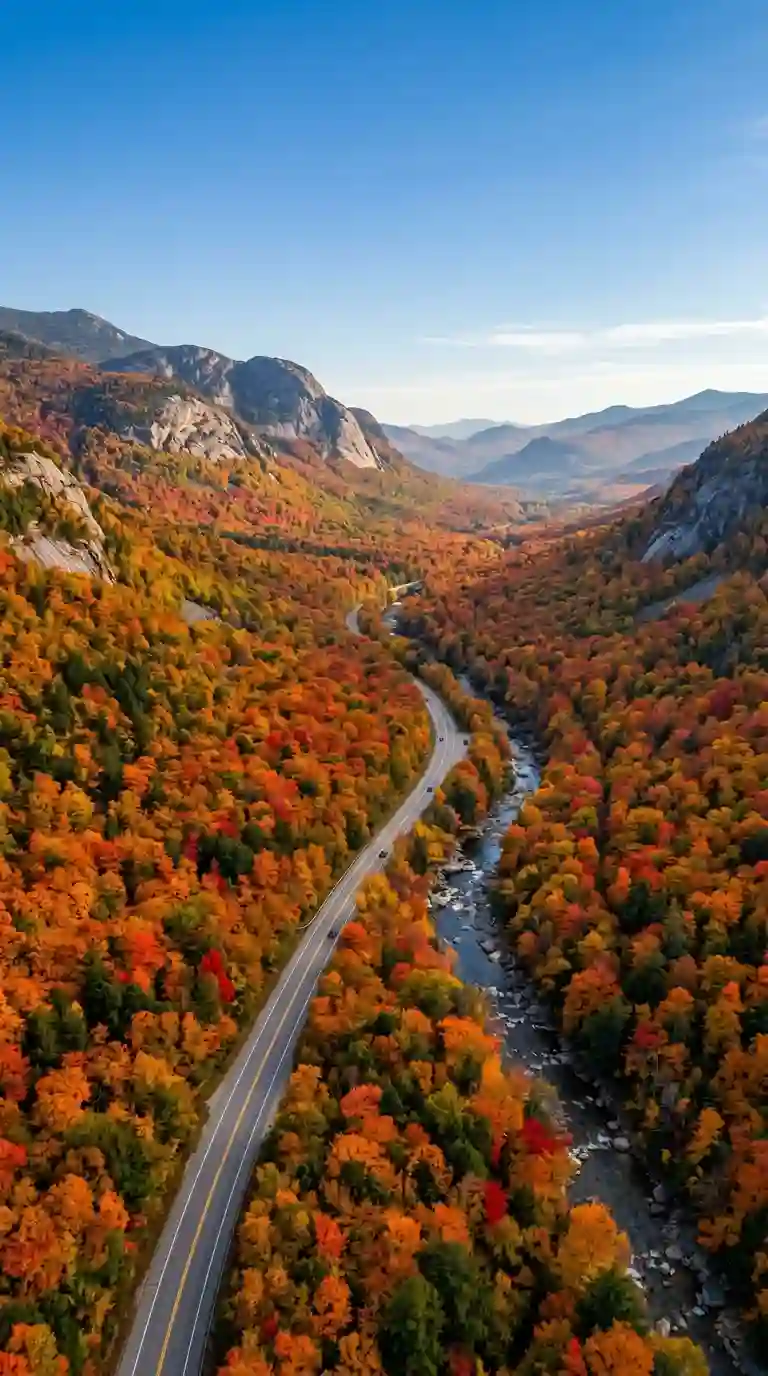
The White Mountains are what happens when you take New England color and add real mountain drama. Granite peaks, deep notches, and rivers tumbling over boulders all frame the leaves, so every view feels bigger and wilder than a typical village scene.
Start with the Kancamagus Highway, a roughly 34-mile scenic road between Lincoln and Conway. There are overlooks every few miles, and the whole drive can take an hour or an entire day depending on how often you stop. Don’t miss Sabbaday Falls, a short walk with a lovely payoff. Then head to Franconia Notch, take the aerial tramway up Cannon Mountain for a bird’s-eye view, and walk to the Flume Gorge if it’s open. Bretton Woods, with Mount Washington looming overhead, is another gorgeous spot for views and a slow lunch.
If you’d rather be on foot, there’s no shortage of trails, from easy lakeside loops to proper summit hikes. Just remember that mountain weather turns quickly in October, so pack layers even when the valley looks sunny.
Best time to visit: Higher elevations and the north often peak in late September to early October, with the valleys and southern areas hitting their stride a week or two later.
Local tip: Start the Kancamagus early in the morning. You’ll get softer light and far fewer cars, and you can finish the day in North Conway.
3. Acadia National Park and Coastal Maine, USA
Most foliage trips are about forests and hills. Maine adds something rare: the ocean. In Acadia National Park, red and gold leaves tumble down to granite shorelines and deep blue water, and the contrast is honestly hard to beat.
Bar Harbor makes a convenient base, with plenty of food and lodging. From there, drive the Park Loop Road, walk the carriage roads (they’re closed to cars, which makes them peaceful and perfect for biking), and take an easy stroll around Jordan Pond. For a bigger view, head up Cadillac Mountain. In autumn it’s one of the first places in the United States to catch the morning sun during part of the year, and a clear sunrise there is something you’ll talk about for years. Bring a hat. It’s cold and windy up top before breakfast.
If you have extra time, venture beyond the park. Inland Maine, around Rangeley and Moosehead Lake, tends to color early and sees far fewer visitors. Pair it with a lobster roll on the coast and you’ve got a classic autumn trip.
Best time to visit: Usually the first half of October, with inland areas often earlier.
Local tip: Reserve ahead for Cadillac Mountain sunrise during the busy season, as timed vehicle reservations have been required in recent years. Check the park site before you go.
4. The Berkshires, Massachusetts, USA
The Berkshires are the answer to “I want foliage, but I also want a great dinner and a comfortable bed.” This corner of western Massachusetts mixes rolling hills with cozy towns, galleries, concert halls, farm stands and some seriously good restaurants.
Drive the Mohawk Trail (Route 2) for sweeping views and old-fashioned roadside stops, or climb Mount Greylock, the state’s highest peak, for a panorama that can stretch across several states on a clear day. Lenox, Stockbridge and Great Barrington make good bases. Stockbridge in particular has that postcard main street feeling, with leaves drifting across the lawns.
It’s also a lovely place for travelers who don’t want to hike all day. You can spend a morning at a museum, an afternoon on a gentle trail, and an evening by a fireplace without feeling like you missed anything.
Best time to visit: Typically the first three weeks of October, often a touch later than Vermont and New Hampshire.
Local tip: Combine the Berkshires with a day trip into Vermont’s southern edge or the Hudson Valley for a longer road trip.
5. The Adirondacks and Catskills, New York, USA
New Yorkers are lucky. Without leaving the state, they have two of the best foliage regions in the Northeast.
The Adirondacks are huge, wild and dotted with glittering lakes. Lake Placid, Saranac Lake and the High Peaks region deliver postcard views, and the Adirondack Scenic Railroad runs fall foliage rides for anyone who’d rather watch the colors roll by from a train window. Whiteface Mountain’s veterans memorial highway offers one of the most sweeping drives in the region when conditions allow.
The Catskills, only a couple of hours from New York City, are more intimate. Hunter Mountain, Woodstock, Phoenicia and Kaaterskill Falls give you easy trails, art-filled towns and cozy diners. If you’re short on time, this is the best quick escape from the city. Even better, you can often catch color there a bit later than in the far north, which extends your window.
If you only have a day and live in or near the city, even the botanical gardens and larger parks can surprise you with how beautiful they look when the trees turn.
Best time to visit: Adirondacks often peak from late September through mid-October. The Catskills tend to peak in the first half to middle of October.
Local tip: Weekend traffic on routes leaving the city can be rough. Leave early Saturday, or go on a weekday if your schedule allows.
6. Shenandoah National Park and Skyline Drive, Virginia, USA

Skyline Drive is one of those roads that sells itself. It’s 105 miles of winding mountain road running the full length of Shenandoah National Park, with around seventy overlooks facing out over the Shenandoah Valley on one side and the Piedmont on the other. In October, the ridges roll away in layers of blue, with every slope glowing in orange, red and gold.
It’s an easy drive, but don’t rush it. The speed limit is low for a reason, and the best views are the ones you stumble on. Add a hike to make it special. Stony Man is short and rewarding, and Hawksbill and Old Rag are more demanding, with Old Rag being a famously rugged rock scramble that requires planning and permits in busy season.
Because it sits farther south than New England, Shenandoah colors later, which is perfect if you missed the northern peak. This year, early forecasts pointed to a later-than-normal season across parts of Virginia, so plan for late October into early November in the lower areas.
Best time to visit: Higher elevations often turn first in early to mid October, with the broader park peaking in the second half of October.
Local tip: Entry is by vehicle fee, and weekends in peak season can mean long lines at the gates. Weekday mornings are your friend.
7. Blue Ridge Parkway and the Great Smoky Mountains, USA
If you love road trips, this one is a gift. The Blue Ridge Parkway stretches roughly 469 miles through Virginia and North Carolina, and because it climbs and drops through so many elevations, you can chase color for weeks by simply driving higher or lower.
The area around Asheville, Boone and Blowing Rock is especially lovely, with craft breweries, mountain cafes and endless overlooks. Grandfather Mountain and Linville Falls are favorites. Then there’s the Great Smoky Mountains National Park, where the highest ridges can start turning in early October while the lower valleys stay colorful into November. Newfound Gap Road and Clingmans Dome offer long mountain views and a big payoff for relatively little effort.
The southern Appalachians have unusually diverse forests, which means more variety in color. You get fiery red maples, golden hickories, deep burgundy sourwoods and brilliant yellow poplars all mixed together. It’s less uniformly scarlet than New England, but I find the mixture beautiful.
Best time to visit: High elevations from early to mid October, lower areas from mid October into early November.
Local tip: Check the Parkway for closures before you go. Storm damage and repairs can close sections, and signal is patchy, so download offline maps.
8. The Upper Peninsula, Michigan, USA
If the busy Northeast isn’t your speed, try the Upper Peninsula. It’s wild, quiet and full of surprise. Hardwood forests roll all the way down to the shore of Lake Superior, and in early autumn the whole landscape lights up.
The Porcupine Mountains Wilderness State Park is a highlight. The Lake of the Clouds overlook is the shot everyone comes for, with a winding lake framed by a sea of color. Tahquamenon Falls, with its rusty, tea-colored water, is another stunner, and Pictured Rocks National Lakeshore adds sandstone cliffs and cobalt water into the mix. Copper Harbor, at the tip of the Keweenaw Peninsula, often has some of the earliest and best color in the Midwest.
You’ll find smaller crowds, great pasties (a local specialty you must try), and wide-open space. It’s a long drive from most places, but that’s part of the reward.
Best time to visit: Late September to early October, with the far north peaking first.
Local tip: Services can be sparse. Fill your tank often and book lodging early, since towns here are small.
9. Aspen and Kebler Pass, Colorado, USA

Colorado does fall differently. Instead of reds and oranges, the show here is gold. Aspens turn a glowing yellow that looks almost like stained glass when sunlight hits it, and their white trunks make whole hillsides shimmer in the wind.
Aspen is the famous base, and the Maroon Bells are the postcard view, though you’ll need to plan ahead for shuttle or reservation requirements in peak season. For something quieter, drive Kebler Pass near Crested Butte, home to one of the largest aspen groves in the state. Boreas Pass near Breckenridge, Independence Pass, the San Juan Skyway around Telluride and Ouray, and the Million Dollar Highway are all fantastic too.
The season is short, and it moves fast, so timing matters more here than almost anywhere else. Early storms can strip leaves in a day. This year’s forecasts suggested parts of the Rockies might not be as spectacular as in some recent seasons, so check conditions and be ready to move to a different elevation or valley if needed.
Best time to visit: Mid September to early October, depending on elevation. Higher areas go first.
Local tip: Go at sunrise or late afternoon. Backlit aspens are unforgettable, and the roads empty out as the light goes golden.
10. Columbia River Gorge, Oregon and Washington, USA
The Pacific Northwest isn’t the first place people think of for fall color, which is exactly why the Columbia River Gorge feels like a secret even when it isn’t. Bigleaf maples, black cottonwoods, vine maples and oaks turn gold, amber and crimson against a backdrop of basalt cliffs, mossy forest and some of the most photogenic waterfalls in the country.
The Historic Columbia River Highway is the classic route, passing Vista House, Latourell Falls, Horsetail Falls and the famous Multnomah Falls. Wahkeena Falls and Oneonta Gorge area trails offer quieter walks when open, though some sections have been affected by past wildfire closures, so check current trail status. Across the river on the Washington side, you can drive more peacefully with big river views. And Mount Hood, with its alpine meadows and orchards in the Hood River Valley, adds another layer of color and fresh apples to eat in the car.
This region has had a tough few years because of drought and fire, and forecasts for parts of the interior Northwest this season were more cautious. The lower gorge, with its moist microclimate, tends to hold up better than drier inland areas.
Best time to visit: Mid October to early November.
Local tip: Timed-entry rules have applied to the Multnomah Falls corridor on the old highway at busy times. Check before you go, and consider arriving at dawn.
11. The Eastern Sierra, California, USA
California surprises people. It doesn’t have New England’s blanket of maples, but the Eastern Sierra delivers something arguably more dramatic: golden aspens and cottonwoods tucked under jagged, granite peaks, reflected in mirror-still alpine lakes.
The stretch along Highway 395 between Bishop and Lee Vining is the heart of it. Favorites include McGee Creek, Convict Lake, Rock Creek, Lundy Canyon, Bishop Creek Canyon and the June Lake Loop, which is probably the single best short drive for color in the state. Lundy Canyon, in particular, is a stunner, with beaver ponds, waterfalls and aspens in one small valley.
You can base yourself in Bishop, Mammoth Lakes or June Lake, and the drive itself is half the fun. Early-season outlooks this year suggested the Sierra could see decent color, with calm weather helping the leaves last through much of October.
Best time to visit: Early to late October, with higher elevations first and lower canyons later.
Local tip: Start at higher lakes early in the month and work your way down in elevation as the weeks go by. A single trip can follow the color for days.
12. Quebec and the Laurentians, Canada

Quebec is where fall foliage gets a French accent. In the Laurentian Mountains north of Montreal, the maples turn in enormous sweeps of red and orange, and the lakeside villages around Mont-Tremblant and Saint-Sauveur feel made for strolling, eating and warming up with something strong and hot.
The province is also one of the best foliage trips if you love culture. Old Quebec City, with its stone walls, narrow streets and the Château Frontenac towering over the St. Lawrence, looks wonderful under a canopy of red leaves. Take a short drive out to Montmorency Falls, then wander the Île d’Orléans for farm stands, cider and cheese. In the Eastern Townships, rolling farmland, vineyards and little barns make for peaceful drives, and Parc national du Mont-Orford and Parc de la Gorge de Coaticook offer great hikes and suspension bridges.
Quebec also makes great food part of the trip. Maple taffy, poutine, tourtière, fresh-baked bread and local ciders are all part of the experience. It’s the rare foliage destination that feels equally rewarding in the rain.
Best time to visit: Late September to mid October, with the Laurentians often peaking first.
Local tip: Book Quebec City early for Thanksgiving weekend in Canada (second Monday of October), when it gets especially busy.
13. Algonquin Provincial Park, Ontario, Canada
Algonquin is the foliage trip for people who’d rather paddle than park. Located a few hours north of Toronto, it’s a vast stretch of lakes, rivers, rock outcrops and forest, and in autumn it lights up with maples, birches and poplars in deep red and gold.
Highway 60 runs through the southern edge of the park and gives easy access to trailheads and lookouts. The Lookout Trail and Booth’s Rock Trail offer big views for modest effort, while Mizzy Lake and Beaver Pond trails are good for spotting wildlife. If you’re up for it, rent a canoe and paddle one of the quieter lakes. The reflections in still water at sunrise are some of the best you’ll see anywhere.
Don’t miss the nearby Muskoka and Haliburton regions either. They’re closer to Toronto and equally beautiful, with cottage-country charm and fewer crowds.
Best time to visit: Late September to early October.
Local tip: Weekends in the park can be crowded, especially on the Lookout Trail. Go on a weekday or at first light.
14. Kyoto, Japan

If you ask people who have seen autumn in many countries where it’s most beautiful, plenty will say Kyoto. And honestly, it’s hard to argue. Here, fall color isn’t just scenery. It’s a centuries-old tradition called momijigari, or “autumn leaf hunting,” and the city’s temples, gardens and hillsides seem designed to frame it.
Some of the classic spots are Kiyomizu-dera, where the wooden stage looks over a valley of burning maples, Tofuku-ji with its famous bridge over a sea of red, Eikan-do with its lit-up evening openings, and Arashiyama, where the bamboo grove, the Togetsukyo Bridge and Tenryu-ji garden can be combined in one long day. Quieter favorites include Kōdai-ji, Shōren-in, Daigo-ji, and the mountain temples of Takao and Ohara, where you’ll find fewer tour groups. The Philosopher’s Path, a canal-side walking route, is also lovely when the leaves fall.
There’s a catch. Kyoto in peak season is very, very busy. The solution is simple: go early, go to the lesser-known temples, and build in time for tea, tofu, or a quiet lunch.
This year, Japanese forecasters expected the season to run a little later than normal because of the warm weather. Red maple peak in Kyoto was forecast around the middle of December in one early outlook, with ginkgo yellows coming sooner, in late November. Forecasts shift, so check the latest before booking.
Best time to visit: Typically late November to early December.
Local tip: Many temples run special evening illuminations during the season. They’re worth it, but buy tickets early and expect queues.
15. Nikko and Lake Chuzenji, Japan
Kyoto gets the fame, but Nikko is Japan’s best-kept foliage secret for anyone based in or near Tokyo. It’s about two hours away by train, and the combination of elaborate shrines, mountain lakes, waterfalls and forested valleys is incredible.
The Irohazaka winding road climbs up to Lake Chuzenji and is one of the most beloved drives in the country, with dozens of hairpin turns hugging the hillside and views that explode into color in autumn. Kegon Falls drops dramatically nearby, and the Senjogahara marshland, with its boardwalks and golden grasses, offers an entirely different view. Back in town, Toshogu Shrine and its surrounding grounds are full of carved gates and cedars, and they look stunning with a few red maples mixed in.
Because of the elevation, color here arrives earlier than in the lowland cities, so it’s a good option if you want an early autumn trip.
Best time to visit: Mid October to early November, with higher areas first.
Local tip: Traffic on the Irohazaka can be heavy on peak weekends. Consider the bus or go on a weekday.
16. Seoraksan National Park, South Korea
South Korea takes autumn seriously. Every year, the country’s forest service releases foliage forecasts, and families, hiking clubs and tour groups plan weekends around the news. When you see Seoraksan, you understand why.
This national park, in the northeast of the country, is famed for its jagged granite peaks, waterfalls, deep valleys and temples, and in autumn it all comes together under a quilt of red maples and golden oaks. The cable car to Gwongeumseong Fortress is the easiest way to get a bird’s-eye view, and the trail to Biryong Falls and Ulsanbawi Rock are two of the most popular hikes. The Osaek area, with its hot springs, is another great spot to base yourself.
This year, the Korea Forest Service forecast peak color at Seoraksan around October 20, with nationwide peak in late October and ginkgo and maple peaks a little later. That’s very close to now if you’re reading this in early October, so Korea could still be a last-minute possibility.
If you have extra time, Naejangsan, Odaesan and Jirisan are other classic Korean foliage mountains, and cities like Seoul have beautiful ginkgo-lined avenues and palace gardens that are especially pretty in November.
Best time to visit: Mid to late October, with nationwide color continuing into November.
Local tip: Weekends are packed. If you can, visit on a weekday and take the first cable car of the morning.
17. The Engadin Valley, Switzerland
Here’s a different kind of fall color. Instead of maples, Switzerland’s Engadin Valley is famous for larch trees, one of the only conifers that turn gold and drop their needles every autumn. The result is whole mountainsides glowing a soft, honey-yellow beneath bright blue skies and snow-dusted peaks.
The area around St. Moritz, Sils Maria, Silvaplana and Pontresina is gorgeous. Take a walk through the larch forests around Lake Sils and Lake Silvaplana, or ride the Bernina Express train for incredible mountain views. The Val Roseg valley near Pontresina is another peaceful spot, and the Swiss National Park, nearby, is a beautiful place to walk and see wildlife.
Autumn here is wonderfully calm. The summer rush is over, the ski crowds haven’t arrived, and you can often find hotel deals, quiet trails and cozy restaurants serving mountain cheese and hot soup.
Best time to visit: Mid to late October.
Local tip: Some mountain lifts and hotels close for a short off-season break in November. Check opening dates before you go.
18. The Dolomites, Italy
The Dolomites are jaw-dropping in any season, but autumn adds a special kind of magic. Larch forests blush gold at the base of rose-colored peaks, villages smell of woodsmoke, and the crowds of high summer start to thin out.
The Seiser Alm (Alpe di Siusi), Val Gardena, the Tre Cime di Lavaredo area, and Lago di Braies are famous spots. In the quieter Val di Funes, you can see a tiny church with the jagged Odle peaks behind it, which is one of the most photographed views in the Alps. The Passo Giau and Cinque Torri are two more wonderful places to catch the larch gold.
Autumn in the Dolomites is also food season, with local Törggelen traditions in South Tyrol that combine roasted chestnuts, new wine and hearty cuisine. It’s a wonderful reward after a day of hiking.
Best time to visit: Early to late October, with larches peaking mid October.
Local tip: Early snow can close high passes without warning. Keep your plans flexible and check road conditions before driving.
19. The Black Forest, Germany
The Black Forest has always had a fairytale quality, and in autumn it feels even more like something out of a storybook. Dark evergreen forests mix with golden beech and orange maple, and mist sits in the valleys in the morning, making every viewpoint look dreamy.
The Schwarzwaldhochstrasse (Black Forest High Road) offers sweeping views, and the Triberg waterfalls, Titisee and Schluchsee lakes, and Feldberg, the region’s highest peak, are all lovely in fall. Small towns like Gengenbach, Freiburg and Baden-Baden give you great food, thermal spas and cobbled old streets to explore. And of course, you can’t leave without trying a slice of Black Forest cake or a plate of local smoked ham.
It’s also one of the easiest foliage trips in Europe, with excellent trains and well-marked trails that make it simple to explore without a car.
Best time to visit: Mid October to early November.
Local tip: Fog can make mornings atmospheric but can also hide views. Give yourself more than one day if you want clear conditions.
20. Hunza Valley, Pakistan

Saving one of the world’s most spectacular autumn landscapes for last was deliberate. Hunza Valley in Gilgit-Baltistan is the kind of place that looks unreal in photographs and somehow more unreal in person.
Every autumn, the valley turns into an ocean of gold, orange and crimson as apricot, poplar, walnut and willow trees change color against towering snow-covered peaks. The village of Karimabad is the usual base, with Baltit Fort and Altit Fort sitting above terraced fields and a view of Rakaposhi and Ultar Sar that stops you in your tracks. Eagle’s Nest viewpoint at Duikar is famous for sunrise and sunset, and Attabad Lake and Passu, with its Cathedral peaks, add turquoise water and drama. Nearby Nagar Valley and Gulmit are quieter and equally beautiful.
What makes Hunza special isn’t only the scenery. It’s the people, the dried-apricot snacks, the walnut cake, the chapshuro and the long, slow chai breaks on a rooftop looking at mountains. It’s a travel experience that stays with you.
Best time to visit: Mid October to early November, when the valley glows gold.
Local tip: Check road conditions and local travel advisories before you go, since mountain roads can be affected by weather and landslides. Pack warm layers, as nights get cold quickly.
How to Plan the Perfect Fall Foliage Trip
A great foliage trip is less about luck than most people think. Here’s how to stack the odds in your favor.
Watch the Forecasts, But Stay Flexible
Foliage maps and forecasts from sources like state tourism boards, national forest services and travel publications are genuinely useful. They use temperature, rainfall and daylight data to estimate when color will peak. But they’re predictions, not promises. Plan your trip around a window of a week or more rather than one exact date, and check live reports the week you leave.
This year, many forecasts suggested a slightly later than normal season across parts of the mid-Atlantic and Japan, and a potentially different pattern in the Rockies and Northwest because of dry conditions. Early storms or high winds can also strip leaves before the peak, so keep a backup plan.
Chase Elevation and Latitude
Color moves from north to south and from high ground to low ground. If you arrive early, go higher or farther north. If you’re late, go lower or farther south. In places like the Smokies, the Sierra or Colorado, you can sometimes find peak color simply by driving an hour up or down a mountain.
Avoid the Crowds
Popular foliage areas can get packed, especially on weekends. A few tricks help:
- Travel on weekdays whenever possible.
- Start your day at sunrise. Light is better and roads are empty.
- Choose a second-tier destination (Peacham instead of Stowe, Lundy Canyon instead of Mammoth, Takao instead of Arashiyama).
- Book hotels and rentals as early as you can. Good places sell out months ahead.
What to Pack
Autumn weather is moody. Pack layers, a waterproof jacket, comfortable walking shoes or boots, a warm hat and gloves for mornings, and a small daypack with water and snacks. A power bank is smart if you’ll be using your phone for maps and photos, and a lens cloth helps with foggy mornings. If you love photography, bring a polarizing filter, which cuts glare on wet leaves and deepens the colors beautifully.
Tips for Better Foliage Photos
- Shoot in soft light. Overcast days make colors richer than harsh midday sun.
- Look for backlight. Leaves glow when the sun is behind them, especially early or late in the day.
- Add water. Lakes, streams and puddles double your color with reflections.
- Include something human. A cabin, a bridge or a person in a red coat gives the photo scale.
- Don’t forget the ground. Fallen leaves on a path can be just as beautiful as trees overhead.
Be a Good Leaf Peeper
Stay on marked trails, don’t pick branches or pull leaves, park only in designated areas, and be kind to small towns that are suddenly very busy. Buy lunch locally, say thank you, and leave places better than you found them.
Best Foliage Trips by Travel Style
Still can’t decide? Here’s a quick cheat sheet.
- Best for a romantic getaway: The Berkshires, Quebec City, Hunza at sunset.
- Best for road trippers: Blue Ridge Parkway, Skyline Drive, Kancamagus Highway.
- Best for hikers: White Mountains, Seoraksan, the Dolomites.
- Best for photographers: Eastern Sierra, Kyoto, Hunza Valley.
- Best for families: Vermont, Catskills, Algonquin.
- Best last-minute trips right now: Seoraksan in South Korea, the Blue Ridge and Smokies, Shenandoah, the Eastern Sierra.
- Best if you hate crowds: Upper Peninsula in Michigan, Engadin Valley, Northeast Kingdom in Vermont.
Frequently Asked Questions About Fall Foliage Destinations
What is the single best place to see fall foliage?
There’s no perfect answer, since it depends on what you want. For classic, postcard-style color, Vermont and New Hampshire are hard to beat. For history and temples, it’s Kyoto. For dramatic mountains, it’s Aspen, the Eastern Sierra, the Dolomites or Hunza. Pick the experience first, then choose the place.
When is the best time to see fall foliage?
In the northern United States and Canada, peak color is usually late September through mid October. The Mid-Atlantic and Appalachians follow from mid October into early November, and the Deep South can see color into November. In Japan, Korea and Europe, peak typically runs from mid October through early December depending on location and elevation.
What are the best places to see fall foliage in the United States?
Top picks include Vermont, the White Mountains of New Hampshire, Acadia in Maine, the Berkshires, the Adirondacks and Catskills, Shenandoah, the Blue Ridge Parkway, Michigan’s Upper Peninsula, Colorado’s aspen country, the Columbia River Gorge and California’s Eastern Sierra.
What are the best places to see fall foliage outside the United States?
Kyoto and Nikko in Japan, Seoraksan in South Korea, Quebec and Ontario in Canada, the Engadin Valley in Switzerland, the Dolomites in Italy, the Black Forest in Germany and Hunza Valley in Pakistan are all outstanding.
Is a drought year bad for fall colors?
Often, yes. Severe drought can stress trees, making colors duller or causing leaves to drop early. But conditions vary a lot by region, and even in a rough year there are usually areas with good color. That’s another reason to stay flexible.
Final Thoughts: Pick a Place and Go
Here’s the honest truth about chasing fall color: you will never get it perfectly right. Some years the maples are fiery and electric. Other years, a windy storm arrives the night before you do. But I’ve never met anyone who regretted going. A foggy morning on a Vermont back road, a golden larch forest in the Alps, a temple garden in Kyoto glowing at dusk, a mountain valley in Hunza lit like a lantern. These are the trips people remember.
So pick a destination from this list that fits your budget, your calendar and your mood. Check the latest foliage reports, pack an extra layer, leave a little room for the unexpected, and go. The leaves won’t wait, and neither should you.
Which of these places is on your list this year? If you’ve found a hidden foliage spot of your own, share it in the comments. The best tips always come from fellow travelers.