

Seoul is enormous. Around nine to ten million people live in the city proper, and more than twenty million in the wider metro area. It stretches across a river, a ring of mountains, and hundreds of distinct neighborhoods. That is exactly why choosing where to stay feels so stressful.
Book the wrong area and your trip gets a little harder. You spend forty minutes on the subway every morning, you land in a street that goes quiet at 9 p.m. when you wanted nightlife, or you drag a suitcase up a hill you didn’t know existed. Book the right one and Seoul feels easy. You step out of your hotel and there is a late-night tteokbokki stall, a subway entrance, and a coffee shop you didn’t plan to love.
Also Read : Things to Do in Tokyo: 40 Unforgettable Experiencesd :
This guide covers the best areas to stay in Seoul, who each one suits, and the honest downsides nobody puts in the brochure. If you only have a minute, start with the quick answer below. If you have more time, read on.

The Quick Answer: Where Should You Stay in Seoul?
If you want the short version, here it is.
| If you are… | Stay in | Why |
|---|---|---|
| A first-time visitor | Myeongdong (or Euljiro next door) | Central, walkable, great transit, huge hotel choice |
| Into nightlife and cafes on a budget | Hongdae | Youthful energy, direct airport train, cheap eats |
| Into history and tradition | Insadong / Jongno / Bukchon | Palaces, hanok houses, tea houses at your door |
| Into trendy cafes and design | Seongsu | Seoul’s coolest neighborhood right now |
| Traveling as a family | Jamsil or Gangnam / Samseong | Lotte World, wide pavements, big hotels, parks |
| A luxury traveler | Gangnam, Gwanghwamun, or Namsan | Five-star service and skyline views |
| A food lover seeking an international vibe | Itaewon / Hannam | Global restaurants and bars |
| A shopper chasing deals | Dongdaemun / Myeongdong | Late-night markets and fashion malls |
| Short on time (1–2 nights) | Seoul Station | Airport train and KTX at the doorstep |
There’s no single “best” area, only the best area for you. The rest of this guide helps you work out which one that is.
How to Choose Where to Stay in Seoul (Read This First)
Before comparing neighborhoods, it helps to understand how Seoul works. A few basics will save you time and money.
Seoul is divided by a river, and that matters
The Han River splits the city into Gangbuk (north) and Gangnam (south, literally “south of the river”). Most traditional sights, palaces, and old neighborhoods are north. The glossy business districts, big malls, and K-pop agencies are south. Both halves are well connected by subway, but they feel like two different cities.
The subway is your real “location”
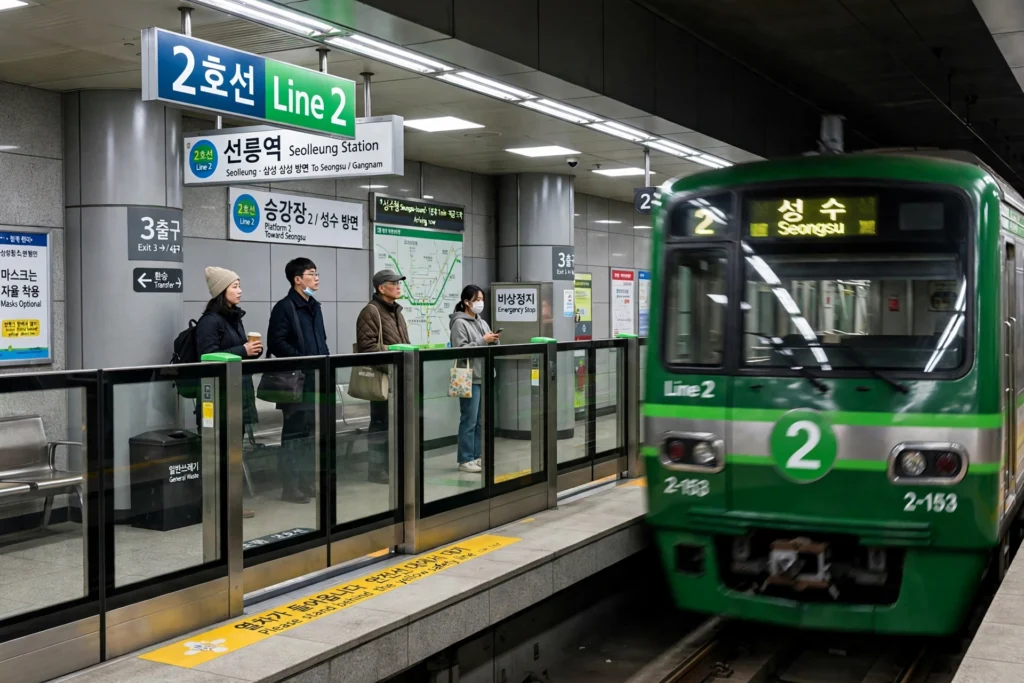
Seoul’s subway is clean, cheap, and runs nine-plus color-coded lines. In practice, a hotel’s distance to a subway station matters more than its distance to a landmark. A hotel five minutes from a station on Line 2 (the green circular line) will serve you better than one that is technically closer to a palace but ten uphill minutes from any train.
Get a rechargeable transit card (T-money or a compatible alternative) on day one. You can tap it for the subway, buses, and many convenience store purchases.
Pick your area by what you will do most
Ask yourself honestly: where will I spend most of my waking hours?
- Mostly sightseeing palaces and museums → stay north of the river, near Jongno.
- Mostly shopping and eating → Myeongdong, Hongdae, or Dongdaemun.
- Mostly nightlife → Hongdae, Itaewon, or Gangnam.
- Mostly cafe-hopping and photography → Seongsu, Seochon, or Yeonnam-dong.
- Mostly business or conferences → Gangnam, Samseong, or Yeouido.
Think about airport logistics
Incheon International Airport is roughly an hour from central Seoul. The AREX airport railroad has two services. The Express runs non-stop to Seoul Station in about 43 minutes from Terminal 1 and about 51 minutes from Terminal 2. The All-Stop train takes around an hour and stops at several stations along the way, including Digital Media City, Hongik University (Hongdae), and Gongdeok. Fares have shifted over the past few years and vary by ticket source. Expect roughly ₩9,500–₩13,000 for the Express (online ticket platforms often discount it) and well under ₩5,000 for the All-Stop with a transit card. Check the official AREX site or your booking platform for the current price.
This is why Hongdae and Seoul Station are so popular for arrivals. You can get there with no transfers at all. Limousine buses also serve many major hotels directly, which is a gift if you have heavy luggage.
Hills, stairs, and luggage
Seoul is built on and around hills. Areas like Bukchon, Haebangchon, and parts of Itaewon involve steep walks. Subway stations usually have elevators, but exits can be many flights of stairs from the street. If you have a stroller, reduced mobility, or two big suitcases, flat areas like Gangnam, Yeouido, and Jamsil are kinder.
Noise and night-time reality
Seoul is a late-night city. Neighborhoods like Hongdae and Itaewon can stay loud until the early hours on weekends. If you are a light sleeper, choose a hotel on a side street, request a high floor, or choose a calmer area.
The 12 Best Areas to Stay in Seoul
1. Myeongdong: Best Overall for First-Time Visitors
Best for: first-timers, shoppers, foodies, short stays
Subway: Line 4 (Myeongdong Station), close to Lines 2 and 3 as well
Vibe: Busy, bright, commercial, endlessly walkable
If you ask ten Seoul travel writers where first-timers should stay, most will say Myeongdong. There’s a reason. It sits in the middle of the city, you can walk to Namsan Cable Car, Namdaemun Market, Deoksugung Palace, and the Cheonggyecheon Stream, and the subway gets you almost anywhere in under half an hour.
What it’s like. By day, Myeongdong is Seoul’s skincare and cosmetics heartland. Shop after shop sells sheet masks, sunscreens, and K-beauty brands, often with staff who speak decent English, Japanese, or Chinese and hand out free samples. After about 5 p.m., the main street fills with street food stalls selling grilled cheese lobster, hotteok, egg bread, and skewers. There’s also a historic cathedral, Myeongdong Cathedral, that feels like a pocket of calm in the chaos.
Hotel choice. This is one of the deepest hotel markets in Seoul. You’ll find everything from simple guesthouses and mid-range business hotels to international chains and iconic five-stars, including long-established luxury properties. Rooms tend to be compact, which is typical across central Seoul, so don’t expect sprawling space at mid-range prices.
Pros
- Central and extremely well connected
- Huge variety of hotels at every budget
- Street food and shopping right outside the door
- Easy walking to major sights
Cons
- Crowded, especially evenings and weekends
- Less “local” than other areas, since you’ll hear more tourists than residents
- Street food prices have crept up compared with other markets
- Can feel overwhelming if you want calm
Insider tip: Many Myeongdong visitors never leave the main strip. Walk ten minutes in any direction and the crowds thin out. Head toward Euljiro or Namsan side streets for quieter local restaurants.
Who should skip it: Anyone who wants a peaceful, residential feel or nightlife with a local crowd.
Must Read : Best Holiday Destinations: 20 Places Worth Booking a Flight For
2. Hongdae: Best for Nightlife, Budget, and Youthful Energy
Best for: solo travelers, couples, nightlife fans, budget travelers, K-pop and indie music lovers
Subway: Line 2, AREX, and the Gyeongui-Jungang line (Hongik University Station)
Vibe: Creative, loud, young, always something happening
Named after Hongik University, one of Korea’s top art schools, Hongdae has the energy of a student district crossed with an art scene. Street buskers, dance crews, indie boutiques, thrift shops, and open-late cafes spill from one lane to the next. If Myeongdong is polished, Hongdae is scrappy and fun.
Why travelers love it. Hongdae gives you the best balance of budget-friendly hotels, hostels, and guesthouses plus a huge dining and drinking scene. Korean barbecue spots, late-night chicken-and-beer joints, noraebang (private karaoke rooms), and clubs all pack into a few blocks. There are also quieter pockets just north in Yeonnam-dong, with leafy lanes and brunch cafes, and Mangwon-dong, with a traditional market.
Airport access. The AREX All-Stop train stops at Hongik University Station, which makes arriving with luggage painless. You walk off the platform and you’re close to your hotel. This alone makes Hongdae a favorite for first and last nights.
Pros
- Excellent value for money
- Direct airport train access
- Seoul’s best nightlife and live-music scene
- Plenty of cafes, vintage shops, and street performers
Cons
- Noisy, especially Friday and Saturday nights
- Further from the main palaces (around 25–30 minutes by subway)
- Can feel chaotic and a little rough around the edges after midnight
- Not ideal for families with young children who sleep early
Insider tip: Hongdae is bigger than it seems. Check your hotel’s exact address. A place near Sangsu or Hapjeong is calmer than one right in the center of the entertainment district.
Who should skip it: Light sleepers who can’t sleep through noise, or travelers wanting traditional Korean atmosphere.

3. Insadong and Jongno: Best for Culture and History
Best for: culture lovers, couples, first-timers who want tradition, older travelers
Subway: Anguk (Line 3), Jongno 3-ga (Lines 1, 3, 5), Jonggak (Line 1)
Vibe: Traditional, cultural, calm in the morning, buzzing in the afternoon
Jongno-gu is the old heart of Seoul. This is where the Joseon dynasty built its palaces, and today it holds Gyeongbokgung, Changdeokgung, and Changgyeonggung within a short walk or ride. Insadong, the neighborhood inside Jongno, is known for tea houses, calligraphy shops, craft stores, and art galleries.
What to expect. Stay here and your morning might begin with a stroll past hanok rooftops, a traditional Korean breakfast, and a palace visit before the crowds. Evenings are for tea, hotteok, and wandering Ikseon-dong’s tiny hanok lanes, a cluster of old houses converted into cafes, cocktail bars, and restaurants.
Hotels. Options range from guesthouses and boutique hotels to mid-range business hotels and a few luxury picks. Many are small and character-filled rather than glossy.
Pros
- Walking distance to palaces, museums, and tea houses
- Authentic atmosphere
- Good for photographers
- Quiet and safe at night compared with entertainment districts
Cons
- Many shops and restaurants close earlier than elsewhere
- Fewer big international hotel chains
- Fewer nightlife options
- Some streets are quite touristy
Insider tip: If you can, spend a night in a hanok (traditional Korean house) stay near Bukchon or Seochon. You sleep on a floor mattress, wake to paper doors and a courtyard, and have a quiet start to the day. It is not for everyone, but it is memorable.
Who should skip it: Nightlife hunters and anyone who wants modern high-rise hotels.
4. Bukchon and Samcheong-dong: Best for a Quiet, Traditional Stay
Best for: couples, photographers, peaceful retreats
Subway: Anguk (Line 3), Gyeongbokgung (Line 3)
Vibe: Quiet, residential, hilly, photogenic
Bukchon Hanok Village is one of Seoul’s most photographed spots. Rows of traditional tile-roofed homes climb a hillside between two palaces. Neighboring Samcheong-dong adds galleries, boutiques, and a long line of stylish cafes.
Important note. Bukchon is a real residential neighborhood. Local authorities have introduced visiting restrictions and time limits for tourists in some lanes because of noise and overcrowding. If you stay here, be respectful: keep your voice low, don’t enter private property, and follow posted signs. Check current rules before you go, since they can change.
Pros
- Beautiful, atmospheric setting
- Peaceful at night
- Walking distance to Gyeongbokgung and Changdeokgung
- Hanok guesthouses with real character
Cons
- Steep hills and many stairs
- Limited restaurants and convenience stores late at night
- Smaller room sizes and shared bathrooms in some traditional stays
- Not very convenient for heavy luggage
Insider tip: Arrive by taxi from the subway if you’re carrying luggage. The final climb can be unforgiving.
Who should skip it: Anyone with mobility concerns or who wants lively evenings.
5. Seongsu-dong: Best for Trendsetters and Cafe Lovers
Best for: return visitors, couples, design lovers, remote workers, shoppers
Subway: Seongsu and Ttukseom stations (Line 2)
Vibe: Industrial-cool, creative, pop-up capital
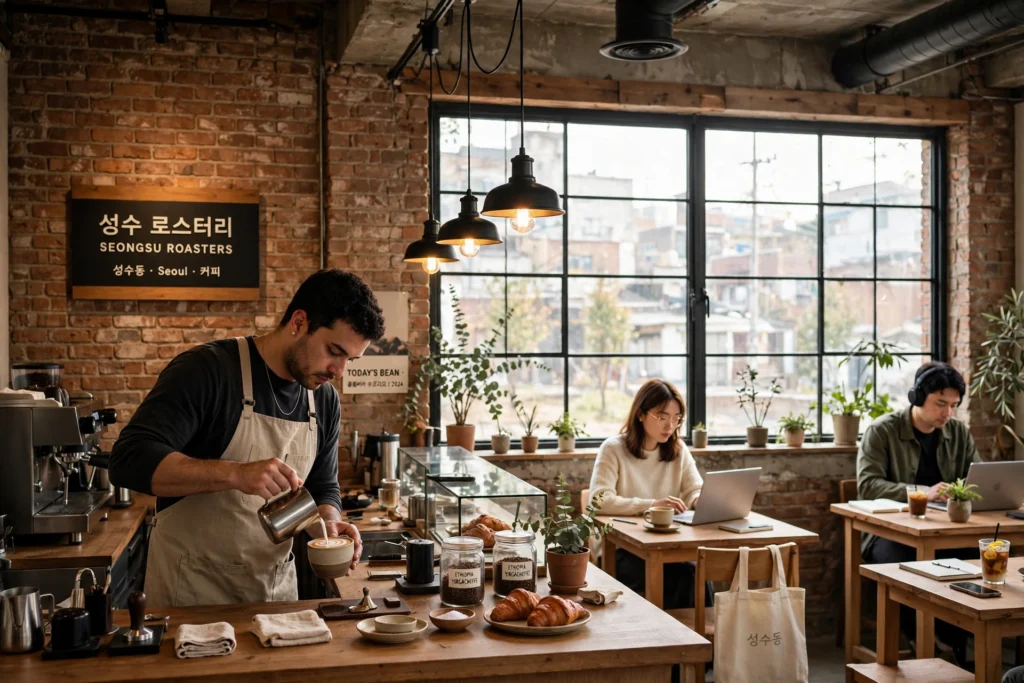
Often called “Seoul’s Brooklyn,” Seongsu is a former factory district reinvented with warehouse cafes, designer pop-up stores, roasteries, handmade shoe workshops, and gallery spaces. Global fashion and beauty brands now regularly stage temporary pop-ups here, which is why you’ll sometimes see queues down the street for a limited-edition store.
Why stay here. If your idea of travel is finding the best flat white, a vintage jacket, and a design store you can’t find elsewhere, this is your neighborhood. Seoul Forest, a large park, is close by, and the Han River is a short ride away.
Hotel reality. Seongsu has fewer traditional hotels than central areas, but boutique and design hotels, serviced apartments, and stays in nearby Konkuk University and Wangsimni are growing. Booking early is smart on busy weekends.
Pros
- Seoul’s best cafe and pop-up scene
- Less crowded with tour groups
- Easy Line 2 access to Hongdae, Gangnam, and Myeongdong
- Walkable and stylish
Cons
- Fewer big-name hotels
- Weekend crowds can be intense around popular shops
- A bit farther from historic sights (about 25–35 minutes)
- Prices have risen as the area has become trendy
Insider tip: Visit on a weekday if you can. Weekend afternoons mean long cafe queues.
Who should skip it: First-timers who mainly want palaces and traditional sights, or those on a very tight budget.
6. Euljiro: Best Hidden Gem for Central Location
Best for: adventurous travelers, couples, design and food lovers, those who want central without the Myeongdong crowds
Subway: Euljiro 3-ga (Lines 2 and 3), Euljiro 1-ga and Euljiro 4-ga nearby
Vibe: Gritty-charming, retro, “hip-jiro”
Euljiro is one of Seoul’s most interesting turnarounds. For decades, it was a district of printing shops, hardware stores, and lighting suppliers. Today, hidden cafes, vintage bars, and tiny restaurants have taken over upstairs rooms and back alleys, and locals nicknamed it “Hip-jiro.”
Why it works for travelers. It sits just next to Myeongdong, Insadong, and Dongdaemun, so you get a central location with a fraction of the tourist bustle. Streets near Euljiro 3-ga in the evening are lined with plastic stools and cold beer, which gives it real local flavor.
Pros
- Central, but more local than Myeongdong
- Great for food, bars, and photography
- Good value hotels compared with the most touristy zones
- Close to both Line 2 and Line 3
Cons
- Streets can feel industrial or rough in places
- Some of the best spots are hard to find and hidden up stairs
- Quiet and a bit empty late at night on certain blocks
- Fewer luxury options
Insider tip: Look for places with no obvious signage. Part of Euljiro’s charm is discovering a door that looks like a printing shop and opens into a cocktail bar.
Who should skip it: Anyone wanting polished, tourist-ready surroundings.
7. Gangnam and Samseong: Best for Luxury, Business, and Modern Seoul
Best for: business travelers, luxury seekers, shoppers, K-pop and K-beauty fans, families wanting modern amenities
Subway: Gangnam (Line 2 and Shinbundang), Samseong (Line 2), Sinsa (Line 3)
Vibe: Glossy, modern, corporate, high-energy
Thanks to a certain viral song, Gangnam is the Seoul neighborhood most people have heard of. In reality, it is a large business and lifestyle district with sleek towers, high-end department stores, plastic surgery clinics, cafes, and some of the city’s best restaurants and bars.
What to see and do. COEX Mall and the Starfield Library, Bongeunsa Temple (a calm Buddhist temple surrounded by skyscrapers), Garosu-gil boutiques in Sinsa, and countless late-night eateries. Samseong, next door, is the home of COEX convention center and major business hotels.
Hotels. Gangnam is full of upscale international chains and modern boutique hotels. Rooms are often larger and newer than in older central areas, and service is polished.
Pros
- Many luxury and business-class hotels
- Wide pavements and modern infrastructure
- Fantastic dining and nightlife
- Great for conferences and events
Cons
- Farther from palaces and old Seoul (30–40 minutes by subway)
- Can feel impersonal and corporate
- Generally more expensive
- Nightlife can feel more club-heavy and pricey
Insider tip: For a quieter Gangnam stay, look at Sinsa and Apgujeong. They have a more boutique feel than the Gangnam Station core.
Who should skip it: Anyone who mainly wants traditional Korea or backpacker-style budget stays.
8. Itaewon and Hannam-dong: Best for International Food and Nightlife
Best for: foodies, nightlife seekers, long-stay travelers, expats
Subway: Itaewon (Line 6), Noksapyeong (Line 6), Hangangjin (Line 6)
Vibe: Cosmopolitan, diverse, party-friendly, hilly
Itaewon is Seoul’s most international neighborhood. Embassies, global restaurants, rooftop bars, and a diverse nightlife scene give it a distinctly cosmopolitan feel. Hannam-dong, just next door, is quieter and more upscale, with galleries, designer boutiques, and fine dining.
Why stay here. It is a good base if you’ve been in Korea a while and want a break from Korean food, or if you love craft cocktails and live music. The adjacent Gyeongridan-gil and Haebangchon (HBC) neighborhoods add quirky bars and indie restaurants.
Reality check. Itaewon is a busy nightlife zone, and after the 2022 crowd crush tragedy, the district has been going through a period of change, with commercial vacancies and a recovering identity in some pockets. Today it remains active, but check recent reviews before booking so you know the current vibe on your chosen street.
Pros
- Huge variety of international cuisine
- Welcoming, diverse atmosphere
- Good hotel options for different budgets
- Close to Namsan and the National Museum of Korea
Cons
- Hills, especially around Haebangchon and parts of Itaewon-ro
- Noisy at night on main streets
- Line 6 is less convenient than Line 2 or Line 3 for reaching some sights
- Some areas feel dated
Insider tip: The Hannam side tends to be calmer. Pick it if you want style without the late-night noise.
Who should skip it: Anyone seeking a traditional Korean atmosphere or a family-friendly, stroller-easy neighborhood.
9. Yeouido: Best for Riverside Calm and Business Travel
Best for: business travelers, couples, runners and cyclists, spring visitors
Subway: Yeouido (Lines 5 and 9), Yeouinaru (Line 5), National Assembly (Line 9)
Vibe: Orderly, spacious, financial district
Yeouido is a river island that serves as Seoul’s finance and broadcasting hub. It is clean, orderly, and surprisingly green. Han River Park is right there for cycling, picnics, and evening walks, and in early April the cherry blossoms along Yunjung-ro are some of the most famous in the country, which is why the area gets packed during bloom season.
Hotel and shopping scene. You’ll find large business hotels, a major department store, and The Hyundai Seoul, a huge mall with indoor gardens. At night, the riverside views and the Seoul Fireworks Festival (usually in autumn) make it feel special.
Pros
- Spacious, clean, and calm after work hours
- Excellent riverside parks
- Fast Line 9 express to Gangnam and the airport (Gimpo)
- Good for business travelers
Cons
- Can feel quiet or empty on weekends and evenings outside the mall and park
- Fewer traditional sights
- Limited budget accommodation
- Fewer street food options compared with older districts
Insider tip: If you’re visiting during cherry blossom season, book months ahead. The area sells out quickly.
Who should skip it: Nightlife seekers and anyone wanting a bustling street scene.
10. Jamsil: Best for Families and Theme Park Fans
Best for: families with children, groups, visitors to Lotte World
Subway: Jamsil (Lines 2 and 8), Jamsil Saenae, Jamsilnaru
Vibe: Modern, family-friendly, residential-meets-entertainment
Jamsil is dominated by Lotte World Tower, one of the tallest buildings in the world, and the connected Lotte World Mall, Lotte World theme park, and aquarium. Add Seokchon Lake, which blooms with cherry blossoms in spring, and you have a neighborhood built for families.
Why families like it. Wide pavements, parks, play areas, indoor entertainment (useful on hot, humid, or freezing days), and hotels with larger rooms make family travel easier. Many hotels offer family rooms and convenient restaurant clusters.
Pros
- Wide streets and stroller-friendly
- Lotte World, an aquarium, and a large mall in one place
- Cherry blossoms at Seokchon Lake in spring
- Good Line 2 and Line 8 connections
Cons
- Quite far from Seoul’s historic center (about 35–45 minutes)
- Feels commercial and modern with less local character
- Can be crowded on weekends and during school holidays
- Pricey for dining inside the malls
Insider tip: Weekday mornings are the best time at Lotte World. Weekends can have very long ride queues.
Who should skip it: Anyone wanting a short transfer to palaces or traditional Seoul.

11. Seoul Station and Namdaemun: Best for Convenience and Short Stays
Best for: one-to-two-night stays, train travelers, late arrivals and early departures
Subway: Seoul Station (Lines 1 and 4, AREX, Gyeongui-Jungang line, KTX)
Vibe: Transit hub, practical, a little rough around the edges
Seoul Station is the city’s primary rail hub. The AREX Express runs to the airport in under an hour, and KTX high-speed trains leave for Busan, Daegu, and other cities. If your itinerary includes a day trip or a stop in Busan, staying here can make sense.
Pros
- Excellent transport connections
- Easy walk to Namdaemun Market and Myeongdong
- Good value business hotels
- Convenient for early flights or trains
Cons
- Lacks charm compared with other areas
- The immediate neighborhood can feel utilitarian
- Fewer dining and cafe options right at the station
- Not a place to “wander”
Insider tip: Seoul Station has an in-station city check-in service for some airlines, which lets you check bags and clear immigration before heading to the airport. It’s a hugely helpful perk for departure day. Confirm availability and your airline’s participation before relying on it.
Who should skip it: Anyone who wants atmosphere. This is a stay for logistics, not for ambiance.
12. Dongdaemun: Best for Shopping, Late-Night Markets, and Design
Best for: fashion lovers, bargain hunters, night owls, budget travelers
Subway: Dongdaemun (Lines 1 and 4), Dongdaemun History & Culture Park (Lines 2, 4, 5)
Vibe: Futuristic design meets wholesale chaos
Dongdaemun is famous for its late-night fashion markets, where wholesalers and shoppers pack into huge mall complexes open into the early morning. The landmark Dongdaemun Design Plaza (DDP), designed by Zaha Hadid, anchors the area with exhibitions, night lighting, and events.
Why stay here. If you plan to shop a lot, particularly for clothes at wholesale prices, it’s perfect. Hotel rates are usually reasonable, and the transport links are great.
Pros
- Late-night shopping
- Very affordable hotels
- DDP’s architecture and exhibitions
- Close to Gwangjang Market and the Cheonggyecheon Stream
Cons
- Crowded and chaotic
- The area feels less residential and less polished
- Not as walkable for sightseeing
- Not ideal for quiet stays
Insider tip: Visit Gwangjang Market for mung bean pancakes, mayak kimbap, and bibimbap. It’s one of Seoul’s best-loved traditional food markets.
Who should skip it: People who don’t care about shopping, or who want calm.
Quick Comparison: 12 Areas at a Glance
| Area | Best for | Vibe | Budget | Walkability | Noise level |
|---|---|---|---|---|---|
| Myeongdong | First-timers | Busy, commercial | $$–$$$ | High | Medium–High |
| Hongdae | Nightlife, budget | Youthful | $–$$ | High | High |
| Insadong/Jongno | Culture | Traditional | $$ | High | Low–Medium |
| Bukchon/Samcheong | Quiet charm | Residential | $$–$$$ | Medium (hills) | Low |
| Seongsu | Trendsetters | Creative | $$–$$$ | High | Medium |
| Euljiro | Local vibe, central | Retro, gritty | $–$$ | High | Medium |
| Gangnam/Samseong | Luxury, business | Glossy | $$$–$$$$ | Medium | Medium–High |
| Itaewon/Hannam | Food, nightlife | Cosmopolitan | $$–$$$ | Medium (hills) | High |
| Yeouido | Calm, business | Orderly | $$$ | Medium | Low |
| Jamsil | Families | Modern | $$–$$$ | High | Low–Medium |
| Seoul Station | Short stays | Transit hub | $–$$ | Medium | Medium |
| Dongdaemun | Shopping | Chaotic, futuristic | $–$$ | Medium | High |
Best Area to Stay in Seoul by Traveler Type
Your travel style can narrow the choice faster than any neighborhood description.
For first-time visitors
Pick Myeongdong or Euljiro. You’ll be central, close to major sights, and never far from a subway station. If you’d like a younger, livelier feel, Hongdae is the best alternative.
For couples
Insadong, Bukchon, or Seongsu give you atmosphere, tea houses, wine bars, and romantic walks. For a more polished stay with city views, look at Namsan or Hannam-dong.
For solo travelers
Hongdae is a social, easy, and safe-feeling base. Myeongdong is great if you want constant activity and transit options at hand. Seoul is generally one of the safer big cities for solo travelers, including solo women, but standard common sense still applies late at night.
For families with children
Jamsil for theme parks and wide pavements, or Gangnam/Samseong for modern amenities and spacious rooms. If your family loves culture, Jongno works well too, though stroller access varies by street.
For budget travelers
Hongdae, Dongdaemun, Euljiro, and Seoul Station tend to offer the best rates. Hostels and guesthouses also cluster in Hongdae and Myeongdong. Staying slightly farther from a main station (a 10-minute walk) can cut the nightly price noticeably.
For luxury travelers
Gangnam, Gwanghwamun, Namsan, and Hannam have the city’s top-tier properties. Look for hotels with Namsan or Han River views, in-house spas, and strong concierge service.
For shoppers
Myeongdong for cosmetics, Dongdaemun for fashion at night, Gangnam (Garosu-gil and COEX) for designer shopping, and Seongsu for independent labels.
For foodies
Itaewon for international cuisine, Euljiro and Jongno for traditional and retro Korean food, Hongdae for casual late-night eating, Gangnam for high-end restaurants.
For digital nomads and long stays
Seongsu, Hongdae, and Hannam have lots of laptop-friendly cafes, serviced apartments, and good Wi-Fi. Seoul is one of the world’s most connected cities, so internet speed is rarely a problem.
For nature lovers
Stay near Namsan for hiking trails or Yeouido for river paths. If you want to go farther, Seongbuk-dong near Bukhansan National Park is a quieter residential area with mountain access.

How Long Will You Stay? Plan Your Base by Trip Length
2–3 nights
Choose one central area, ideally Myeongdong, Euljiro, or Hongdae. Changing hotels in such a short trip wastes a half-day. You want the subway nearby so you can maximize sightseeing.
4–5 nights
You can still use one base, but consider splitting your stay. For example, two nights in Hongdae or Myeongdong for the classic sights and nightlife, plus two or three nights in Seongsu, Itaewon, or a hanok for a different feel.
7+ nights
A split stay is highly recommended. A common combination:
- 3 nights in a central area (Myeongdong, Euljiro, or Jongno) for palaces and first-timer sights
- 2–3 nights in a trendy area (Seongsu or Hongdae)
- 1–2 nights near the airport or Seoul Station for the final night, especially with an early flight
If you’re mixing Seoul with other Korean cities
If you’re headed to Busan, Jeonju, or Gyeongju, Seoul Station is the logical last-night base. KTX trains depart from there, and you avoid a rushed subway transfer with big suitcases.
What Does a Hotel in Seoul Cost?
Prices change by season, day of the week, and booking window, so treat this as a rough guide only, and always check live rates.
- Budget hostels and guesthouses: Roughly $20–$50 per night for a dorm bed or simple private room
- Mid-range hotels: Often $70–$160 per night for a compact, clean, well-located room
- Upper-mid-range and boutique hotels: Around $150–$300
- Luxury hotels: From about $250–$500 and up, depending on the property and season
A few money-saving thoughts:
- Weekdays are often cheaper than weekends in business-heavy areas like Gangnam and Yeouido, and sometimes pricier in leisure areas like Hongdae and Seongsu.
- Peak seasons, spring cherry blossoms (late March to mid-April) and autumn foliage (October to early November), are the most expensive and sell out first.
- Book refundable rates if you can. Seoul’s weather and flight schedules are mostly reliable, but plans change.
- Room sizes are small. If you’re traveling with a lot of luggage or as a family, look for “family room,” “twin,” or “apartment-style” listings rather than assuming a standard double will fit everyone.
Best Time to Visit Seoul (and How It Affects Where You Stay)
Also Read: Fall Travel Guide: Where to Go, When to Book, and How to Make the Most of Autumn
Spring (March–May): Cherry blossoms, mild days. Stay near Yeouido, Seokchon Lake in Jamsil, or Namsan for blooms. Book early.
Summer (June–August): Hot and humid, with a rainy monsoon period often arriving around late June to July. Choose an area with plenty of indoor options, such as Jamsil, Gangnam, Myeongdong (underground passages), or Dongdaemun, and make sure your hotel has strong air conditioning.
Autumn (September–early November): Often considered the best season, with crisp air and golden ginkgo and maple leaves. Palace areas, Bukchon, and Namsan look their best.
Winter (December–February): Cold and dry, with temperatures that regularly drop below freezing. Heated floors (ondol) in a hanok are lovely, but stairs and hills can be icy. Choose a location near the subway, and consider Myeongdong or Hongdae, where indoor shopping and cafes make cold days easy.

Safety: Is Seoul Safe to Stay In?
Seoul is widely regarded as one of the safest major cities in the world. Violent crime against tourists is rare, public transport is safe late into the evening, and you’ll often see people leaving phones or laptops on cafe tables. That said:
- Nightlife districts like Hongdae, Itaewon, and Gangnam can attract drunk and rowdy crowds late at night. Stay aware, watch your drink, and avoid walking alone through isolated alleys at 3 a.m.
- Pickpocketing is uncommon but can happen in very crowded markets and festivals.
- Taxi scams are rare. Use the official taxi stands, a licensed taxi app, or the meter.
- Spiking and drink safety concerns exist in any nightlife area worldwide. Keep your drink in sight.
- Language can be a barrier at times. Save your hotel’s name and address in Korean on your phone to show taxi drivers.
For solo female travelers, areas like Myeongdong, Hongdae, Insadong, and Seongsu feel comfortable, with plenty of lighting and foot traffic. As with any city, trust your instincts and choose accommodation with good reviews that mention safety.
How to Get Around From Each Area
A short cheat sheet of which subway lines connect your base to the sights you’ll want most.
- From Myeongdong (Line 4): Easy to Dongdaemun, Seoul Station, and Namsan. Transfer to Line 2 at Dongdaemun History & Culture Park or Line 3 at Chungmuro for palaces.
- From Hongdae (Line 2 / AREX): Line 2 runs the whole circular route. Transfer at Euljiro 3-ga or Sindorim for Line 3 or other lines. AREX gets you to the airport.
- From Insadong/Jongno (Lines 1, 3, 5): You’re already close to palaces. Line 1 and Line 5 give you wide access.
- From Gangnam (Line 2 / Shinbundang): Line 2 circles the city, and the Shinbundang line connects quickly to Pangyo and the south.
- From Seongsu (Line 2): One line, easy, running to Hongdae, Gangnam, and Euljiro.
- From Itaewon (Line 6): Transfer at Samgakji or Hapjeong to reach Lines 4 or 2.
- From Yeouido (Lines 5, 9): Line 9 Express is the fastest way to Gangnam. Line 5 reaches Gwanghwamun and Jongno.
- From Jamsil (Lines 2, 8): Line 2 connects to Gangnam, Seongsu, and Hongdae.
Practical tips:
- Subway trains generally run from about 5:30 a.m. until around midnight, with some variation by line. After that, take a taxi or a late-night bus.
- Download a map app that works in Korea. Google Maps is limited for walking and driving directions in Korea, so many visitors rely on Naver Map or Kakao Map for accurate directions, including transit.
- Avoid rush hours (about 8–9 a.m. and 6–7 p.m.) when possible. Trains can be shoulder-to-shoulder.
- Most stations have elevators, but they can be tucked far from the exits you need, so give yourself extra time with luggage.
Common Mistakes When Choosing Where to Stay in Seoul
After reading dozens of traveler reports and guides, these are the mistakes that come up again and again.
1. Booking based on price alone. A hotel that saves you $20 a night but sits 15 minutes from the nearest subway can cost you hours of lost sightseeing time and the energy to enjoy them.
2. Assuming everything is walkable. Seoul is huge. Gyeongbokgung to Gangnam is a 30–40 minute subway ride, not a leisurely stroll.
3. Ignoring hills. Many highly rated hotels in Itaewon, Bukchon, and parts of Haebangchon sit on steep slopes. Read the reviews for mentions of “uphill” or “steep.”
4. Not checking the room size. Seoul hotel rooms, especially in central areas, are small. If you’re a family of four, check carefully.
5. Picking Gangnam because it’s famous. Many first-timers choose it expecting a lively tourist district, but it’s primarily a business and shopping zone and may feel far from the cultural sights you came to see.
6. Overpacking your itinerary by switching hotels too often. Every check-out and check-in costs about half a day. Limit yourself to two bases for most trips.
7. Forgetting about the airport. A late-night arrival to a faraway neighborhood can be tiring and pricey. If your flight lands late or leaves early, pick a stay with straightforward airport links.
8. Not checking cancellation policies. Seasons like cherry blossom and fall foliage see price spikes. Book refundable rates and monitor for better deals.
Decision Guide: Pick Your Area in 60 Seconds
Answer these in order and stop at the first “yes.”
- Is this your first visit and you want the easiest possible trip? → Myeongdong.
- Is nightlife and a budget stay your priority? → Hongdae.
- Do you want tradition, tea houses, and palaces at your door? → Insadong/Jongno.
- Do you want cafes, pop-ups, and a trendy scene? → Seongsu.
- Are you traveling with young children and love theme parks? → Jamsil.
- Do you want luxury and modern comfort? → Gangnam or Gwanghwamun.
- Do you crave global restaurants and craft cocktails? → Itaewon/Hannam.
- Are you staying only one or two nights? → Seoul Station.
- Do you want a local, central, quirky base? → Euljiro.
Still stuck? Choose Myeongdong for the first half of your trip and Hongdae or Seongsu for the second half. It’s the most reliable two-base strategy for a 5–7 night trip.
Sample Itineraries Based on Where You Stay
Read Also: Best Things to Do in Tokyo: 40 Unforgettable Experiences
If you stay in Myeongdong (3 days)
- Day 1: Namdaemun Market, Myeongdong Cathedral, Namsan Cable Car, N Seoul Tower at sunset, street food dinner
- Day 2: Gyeongbokgung Palace, Bukchon Hanok Village, Insadong tea house, Cheonggyecheon Stream evening walk
- Day 3: Dongdaemun Design Plaza, Gwangjang Market, a final Myeongdong shopping run
If you stay in Hongdae (3 days)
- Day 1: Hongdae street browsing, Yeonnam-dong cafes, Gyeongui Line Forest Park, night out
- Day 2: Seodaemun Prison History Hall (if interested), Gyeongbokgung Palace, Insadong
- Day 3: Seongsu cafes and pop-ups (on Line 2), Seoul Forest, return for dinner and noraebang
If you stay in Seongsu (3 days)
- Day 1: Seoul Forest, Seongsu warehouse cafes, designer pop-ups
- Day 2: Line 2 to Euljiro for retro bars, then Myeongdong for dinner
- Day 3: Palaces and Bukchon, then back to Seongsu for evening drinks
These are starting points, not rigid plans. Seoul rewards wandering, so leave gaps.

Final Thoughts: So, Where Should You Stay in Seoul?
Read Must: Best Things to Do in London: 45 Unmissable Experiences
If you want a clear recommendation, here it is.
- Myeongdong is the safest, most convenient pick for first-timers. You’ll be central, with lots of hotel choice and constant things to do.
- Hongdae is the best pick for nightlife, budgets, and a young, social atmosphere with straightforward airport access.
- Insadong and Bukchon give you the traditional Korea experience at a slower pace.
- Seongsu is where to go if you want to see modern Seoul culture and the city’s hottest cafe and design scene.
- Gangnam, Jamsil, and Yeouido are better for families, business travelers, and those who like modern comfort and space.
- Euljiro, Itaewon, Dongdaemun, and Seoul Station serve more specific needs, and each can be the perfect base for the right traveler.
Whatever you choose, remember that Seoul’s subway can connect almost any two neighborhoods in under 45 minutes. A “wrong” choice isn’t a disaster. You’ll still have a great trip. But choosing thoughtfully will make your days smoother, your nights better, and your memories sharper.
Pack comfortable shoes, charge your transit card, and get ready for one of the most exciting cities in the world.
Frequently Asked Questions
1. What is the best area to stay in Seoul for first-time visitors?
Myeongdong is the most popular and practical choice for first-timers. It is central, well connected by subway, packed with shops and street food, and offers a wide range of hotels. Euljiro and Insadong are good alternatives if you want fewer crowds or a more traditional feel.
2. Is it better to stay in Gangnam or Myeongdong?
For sightseeing and first-time travel, Myeongdong is usually better because it is close to palaces, markets, and major attractions. Gangnam is better if you are traveling for business, prefer upscale modern hotels, or want a more polished, less touristy environment. Many travelers split their stay between both.
3. Which area of Seoul is best for nightlife?
Hongdae is the top choice for a youthful, club-and-bar nightlife scene with live music and late-night food. Itaewon offers an international crowd and cocktail bars, while Gangnam has more upscale clubs and lounges. Euljiro is great for a retro, laid-back drinking scene.
4. What is the cheapest area to stay in Seoul?
Generally, Hongdae, Dongdaemun, Euljiro, and areas around Seoul Station offer the best-value rooms. Hostels and guesthouses are plentiful in Hongdae and Myeongdong. Prices vary by season, so booking early and choosing refundable rates helps.
5. Where should families stay in Seoul?
Jamsil is excellent for families thanks to Lotte World, an aquarium, a large mall, and Seokchon Lake. Gangnam and Samseong offer larger, modern rooms and wide pavements. If your family is more interested in culture and history, Jongno and Myeongdong also work well, especially with older children.
6. Is Seoul safe for solo travelers and solo women?
Yes, Seoul is considered one of the safest major cities for solo travelers. Public transit is reliable and well lit, and violent crime against tourists is uncommon. As in any city, avoid isolated areas late at night, keep an eye on your drink in nightlife zones, and choose accommodation with strong reviews.
7. How many days do I need in Seoul?
Most travelers find 4–5 days enough to see the highlights, such as palaces, markets, Namsan, and a few neighborhoods. 7 days lets you add day trips (like the DMZ or Suwon Hwaseong Fortress) and explore more neighborhoods at a relaxed pace. For a short trip of 2–3 days, stay in one central base.
8. How do I get from Incheon Airport to my hotel in Seoul?
The AREX airport railroad is the fastest and most reliable option. The Express train runs non-stop to Seoul Station in roughly 43–51 minutes depending on terminal, while the All-Stop train stops at Hongik University (Hongdae), Gongdeok, and other stations in about an hour. Airport limousine buses serve many major hotels directly and are convenient with heavy luggage. Taxis are the most expensive option. Fares change, so confirm current prices on the official AREX site or your booking platform.